
Why Is Medicai the Best for Image Sharing?
Your hospital or clinic still spends hours chasing down imaging discs or waiting for email links that expire. Many platforms force clinicians to switch between systems or accept slow transfers when patients cross care settings.
By the end of this article you will know how Medicai's zero-footprint viewer and cloud PACS work together, how the platform connects multiple sites without extra hardware, and whether its Imaging Infrastructure as a Service fits the case volume and compliance needs of your team.
What Is Medicai?
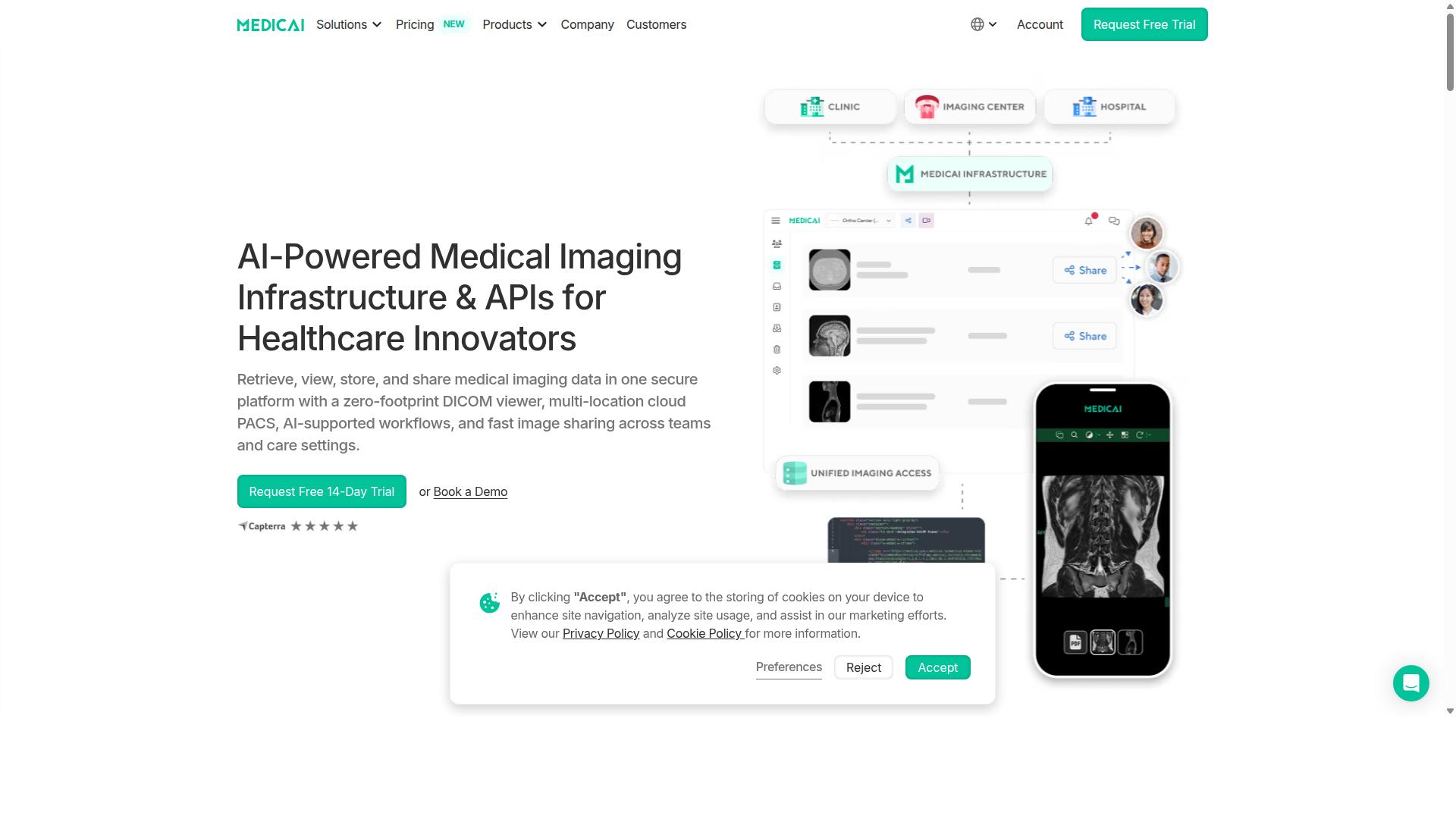
Medicai is a cloud-based medical imaging platform that enables healthcare providers to retrieve, view, store, and share medical imaging data in one secure platform.
The platform features a zero-footprint DICOM viewer that allows providers to access imaging data without installing additional software. Users can access scans from any location through a standard web browser, eliminating the need for local applications or specialized hardware.
Compliance standards include HIPAA and GDPR compliance, with FDA and CEE clearance for medical device use. These certifications ensure the platform meets regulatory requirements for handling protected health information across different healthcare environments.
Global availability allows healthcare organizations worldwide to implement the system regardless of geographic location. The cloud infrastructure supports medical imaging workflows across multiple care settings and team structures.
Medicai operates as Imaging Infrastructure as a Service and includes multi-location cloud PACS capabilities. The company functions as a VC-backed healthcare startup focused on modernizing medical imaging workflows and enabling interoperability between different healthcare systems.
The platform supports AI-supported workflows and provides fast image sharing across teams and care settings. This infrastructure approach allows healthcare providers to access medical imaging data without managing complex local storage systems or hardware requirements.
Why Medicai Is the Best for Image Sharing
Medicai processes over 1M studies per year.
The platform handles 50M+ yearly API transactions.
Over 300k+ DICOM visualizations completed in the last year show that the system supports rapid image review across multiple clinical scenarios.
The platform supports lossless compression and bandwidth optimization for reliable transfers.
These operational capabilities support the 70 clinics and hospitals using the platform. Ten thousand active doctors rely on these performance levels for routine image sharing and specialist collaboration.
Key Features and What Makes Medicai Stand Out
Medicai combines upload, storage, and collaboration tools into a single HIPAA-compliant workflow.
The platform connects imaging departments with referring physicians through HL7 and FHIR APIs that link directly to existing EMR and EHR systems.
Facilities no longer need separate portals or manual file transfers. All imaging activities happen inside the same secure environment that already holds clinical notes and lab results.
Connect & Retrieve
The Medical Imaging Uploader and DICOM Gateway let facilities import studies from any modality without manual CDs or USB drives.
These tools support import from CT, MRI, X-ray, and ultrasound systems. Encrypted transfer protocols move the files to the correct patient record.
Once imported, each study routes to the right case file without staff intervention.
Store & Manage
Cloud PACS and Vendor Neutral Archive provide scalable storage that grows from 500 GB to multiple terabytes while preserving an immutable audit trail.
Automated backup and disaster recovery features protect every study against hardware failure or site outages. Role-based permissions control who can view, edit, or share each record.
HL7 and FHIR tagging keeps more than 1.7 million studies searchable across multiple sites.
Access, Visualize, Collaborate
Specialists and referring physicians open studies instantly in the zero-footprint viewer on any device, enabling secure second opinions and multidisciplinary review.
Real-time annotations and shared worklists allow teams to mark findings and discuss cases while staying inside their EMR workflow. Patient-portal links extend the same access to individuals who need their own images.
These features support consultation workflows. Physicians review studies, add reports, and coordinate care without leaving the systems they already use every day.
Pricing and Plans
Medicai offers transparent monthly subscriptions that start at $249 for 500 GB and scale to $749 for 2 TB with one connected location included.
The Starter plan delivers essential features for smaller practices and independent radiologists. This tier provides 500 GB of cloud storage with unlimited user accounts and no per-study fees.
The Standard plan expands capacity significantly for growing practices. Users gain 2 TB of cloud storage plus one connected location, keeping the same unlimited user accounts and zero per-study charges.
Both pricing tiers eliminate hidden costs that complicate billing in medical imaging platforms. Healthcare teams can focus on patient care and image sharing rather than tracking usage fees.
Yearly billing reduces costs by 15 percent for organizations that prefer annual commitments. The Starter yearly rate equals $209 monthly while Standard drops to $639 monthly, maintaining identical storage and user limits.
Enterprise customers access custom storage amounts with multiple connected locations available. Per-study pricing options exist for facilities with variable imaging volumes and specific workflow requirements.
The DICOM Gateway requires a one-time $1,000 setup fee per location for organizations needing direct PACS integration.
A 14-day trial provides full access to Starter plan features without requiring credit card information.
Trust Signals
HIPAA and GDPR compliance plus FDA/CEE clearance establish Medicai's baseline credibility before partnerships are considered. These certifications set a high bar for any platform handling medical imaging and patient data.
Encryption at rest and in transit protects every DICOM study and clinical record that moves through the system. This encrypted transfer approach keeps sensitive radiology images secure during upload, storage, and retrieval across networks.
Detailed audit logs track every interaction with patient data and imaging studies. These logs record user actions, timestamps, and access events to support compliance reviews and internal security monitoring.
Microsoft Azure and Amazon AWS partnerships provide verified uptime and infrastructure reliability. New Relic integration adds real-time performance monitoring to maintain consistent service levels for medical imaging users.
These technical safeguards work together to support secure image sharing across hospitals, clinics, and remote specialists. The combination of compliance certifications, encryption standards, and monitoring tools gives healthcare organizations confidence when transferring diagnostic studies.
Who Should Use Medicai
Hospitals, outpatient imaging centers, and specialty groups in orthopedics, neurology, oncology, cardiology, and dentistry benefit most from Medicai's scalable cloud platform.
Radiologists who need faster turnaround appreciate the ability to review and share diagnostic imaging without waiting for physical media transfers. The zero-footprint viewer lets them access CT scans, MRI studies, and X-ray images from any workstation while maintaining HIPAA compliance through encrypted transfer protocols.
Surgeons requesting second opinions rely on Medicai to send high-resolution imaging files to specialists across different facilities. The role-based access system ensures that only authorized physicians can view patient studies, while the audit trail documents every interaction with the medical records.
Rural clinics that lack on-premise servers find value in the mobile viewing capabilities. These facilities can upload ultrasound and radiographic images directly from portable devices, then share them with distant radiologists for immediate interpretation without investing in expensive PACS infrastructure.
Virtual care providers and telemedicine platforms integrate Medicai into their workflows through the available integration API. Tumor boards and clinical trials use the platform to coordinate multi-site image review sessions, while medical education organizations access the same cloud platform to display case studies during training sessions.
Personal injury lawyers working with orthopedic and neurology cases use the patient portal to securely receive and review imaging studies for legal proceedings.
Final Verdict
For facilities seeking secure, scalable medical image exchange without capital hardware, Medicai delivers measurable speed and compliance at a predictable monthly cost.
The platform has processed more than 1 million studies annually and stores over 1.7 million studies, numbers that demonstrate consistent performance under real clinical loads.
Healthcare organizations that rely on Medicai avoid the hidden expenses of on-premise servers, maintenance contracts, and emergency storage upgrades. Monthly pricing replaces those surprises with a single line item that scales with study volume rather than hardware purchases.
Facilities can reach Medicai USA at 7901 4th St N, STE 300, St. Petersburg, FL, 33702 or by calling +1 (832) 220 1035. Email inquiries go to [email protected], where staff can schedule a trial and review current integration options.
Recommended Resources: