
Top 7 Alternatives of TeleRay for FDA-Approved Viewer
Most hospitals and imaging centers hit a wall with TeleRay when they need faster image sharing across multiple sites or when they must integrate AI into daily reads. These friction points push teams to hunt for replacements that keep FDA clearance while adding cloud access and modern workflows.
By the end of this guide you will have a side-by-side view of seven FDA-approved options, including Medicai, with clear feature lists, pricing tiers, and decision criteria that match the pain points driving your search. The final sections lay out how to match each platform to your case volume and IT constraints.
What to Look For in an FDA-Approved DICOM Viewer
An FDA-approved DICOM viewer must deliver secure, compliant, and modality-spanning performance across every clinical workflow.
IT teams should verify FDA 510(k) clearance documentation before any purchase decision. Ask vendors to provide the exact clearance letter and device listing number during the RFP process.
Confirm that the platform uses HIPAA and GDPR encryption at rest and in transit. Request the encryption standards and certificate details for both storage and network communication.
Evaluate whether the solution offers zero-footprint browser delivery without client installs. Verify that radiologists can access studies from any workstation without software downloads or local plugins.
Ensure the viewer supports native multi-modality imaging for CT, MRI, X-ray, ultrasound, PET, and nuclear medicine studies. Confirm the system loads each modality without conversion steps or external tools.
Check for quantitative tools including annotations, 3D reconstruction, and image fusion. Request documentation showing measurement accuracy and fusion capabilities across different study types.
1. Medicai - Best Overall
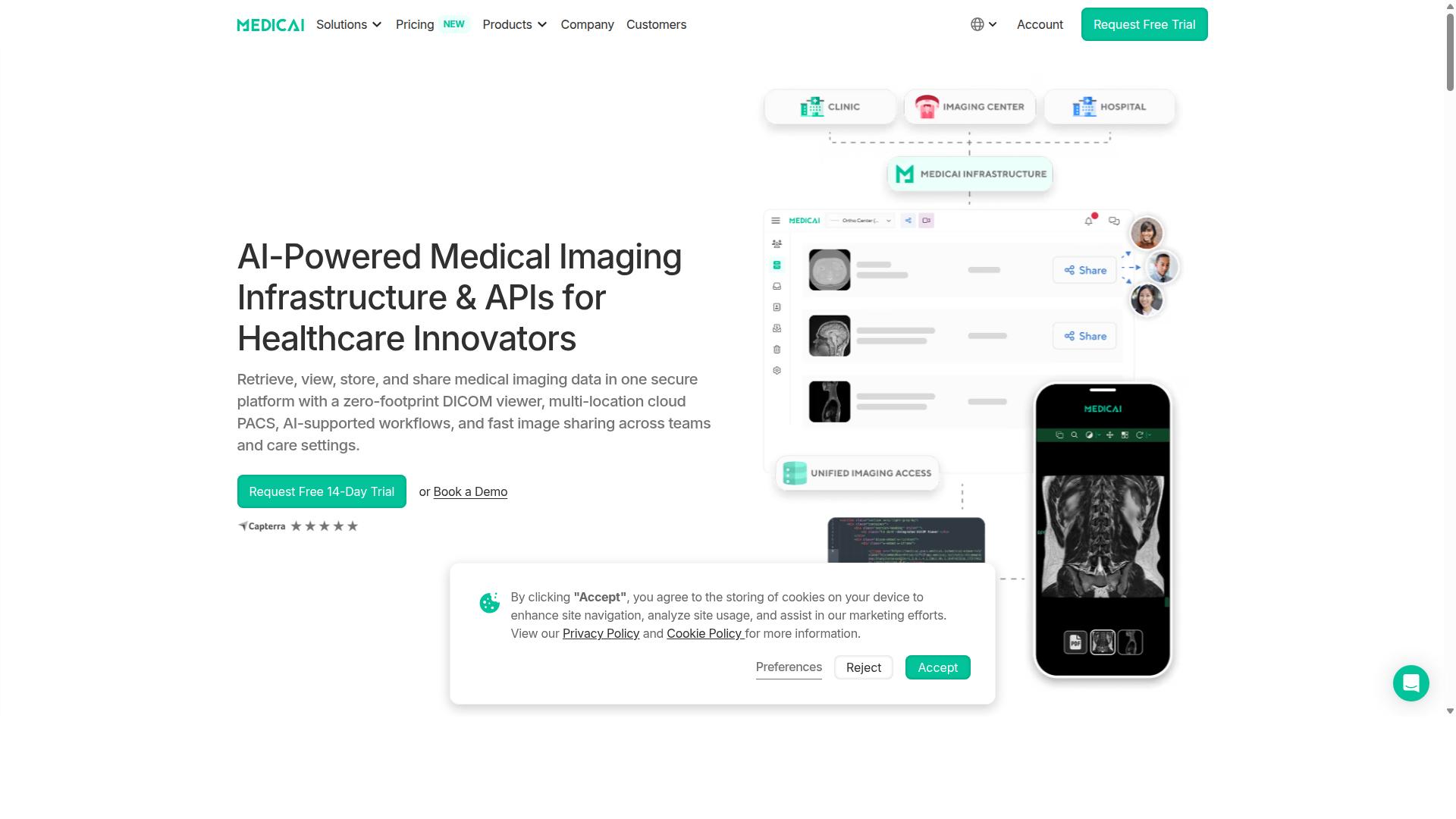
Medicai is positioned as the best overall option because its single cloud platform combines FDA-cleared viewing, unlimited user access, and global availability.
This positioning comes from the platform's ability to handle retrieval, viewing, storing, and sharing tasks in one place. Healthcare teams gain access to connected tools without switching between separate systems for each step in the imaging workflow.
Key Features
Medicai's feature set covers retrieval, viewing, storing, and sharing within one FDA-cleared interface. The platform operates as a zero-footprint viewer that supports API transactions.
The four product pillars organize the main capabilities into distinct areas. Each pillar maps to specific tools that address different parts of medical imaging workflows.
- CONNECT & RETRIEVE includes the Medical Imaging Uploader and DICOM Gateway for bringing imaging data into the system.
- STORE & MANAGE uses Cloud PACS, Vendor Neutral Archive, and Patient Case Management for organizing and maintaining imaging records.
- ACCESS & VIEW centers on the DICOM Viewer for examining studies across different modalities and locations.
- COLLABORATE provides tools for team communication and structured reporting within the same interface.
Pricing & Plans
Medicai offers transparent monthly subscriptions aligned to storage volume and connected locations. The two published tiers provide clear options based on organizational needs and data volume.
Starter costs $249 per month for 500 GB of cloud storage with unlimited user accounts and zero connected locations. Standard costs $749 per month for 2 TB of cloud storage with unlimited user accounts and one connected location.
Overage storage and additional locations carry separate pricing. Enterprise customers can reach sales@medicai.io for custom quotes that match their specific requirements.
2. Studycast
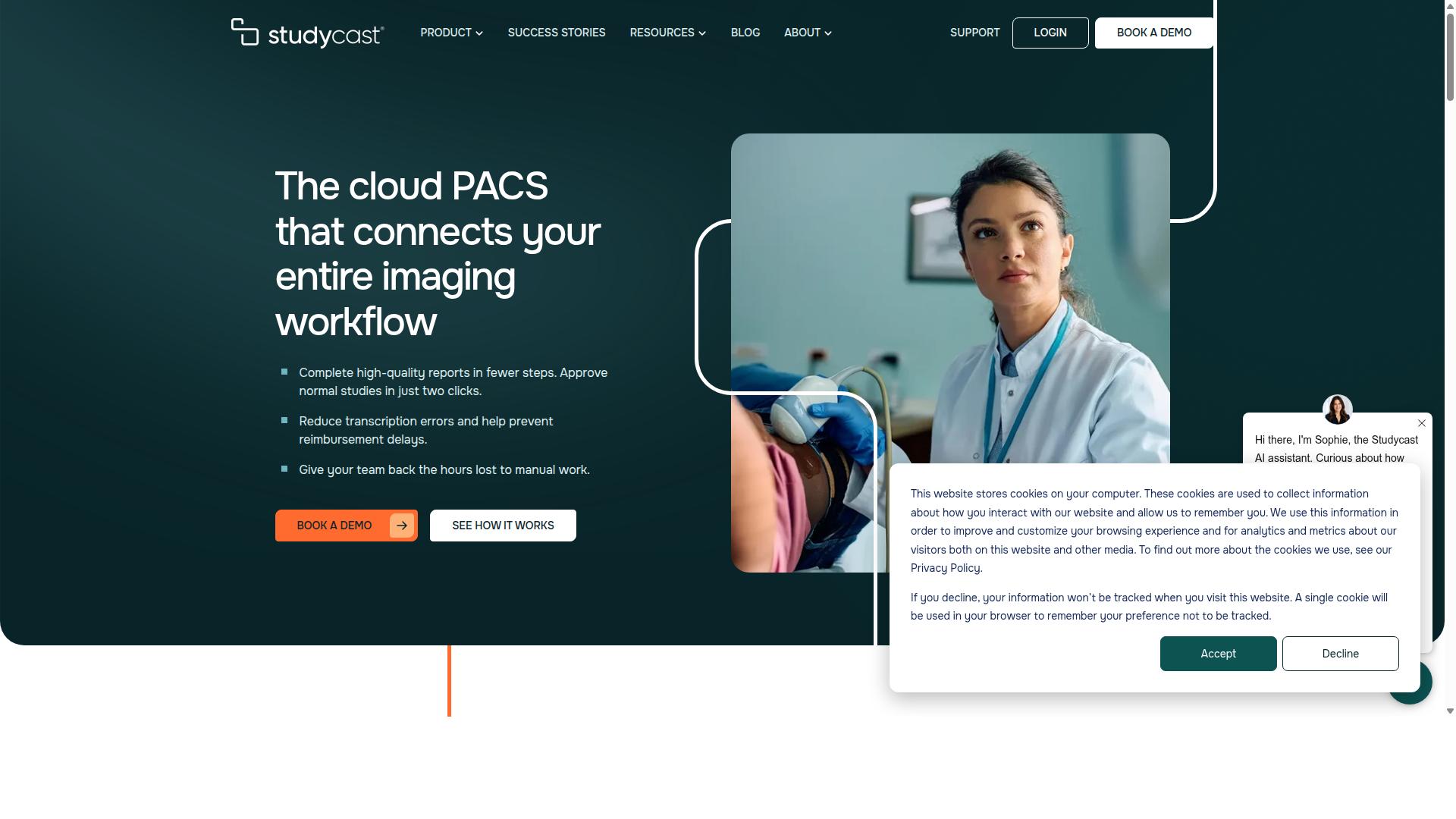
Studycast provides a cloud-based ultrasound workflow solution that emphasizes structured reporting and mobile review. The platform supports multiple imaging modalities including ultrasound, X-ray, MRI, and nuclear medicine studies. Organizations use this system for image review, reporting, and distribution across various clinical settings.
HIPAA-compliant data handling protects patient information during storage and transmission. The solution offers web-based access that allows physicians to review studies from different locations without local installation requirements. This approach suits practices that need consistent access across multiple sites.
Integration capabilities connect with existing electronic medical record systems for streamlined data flow. The platform handles image archiving and sharing functions that support diagnostic workflows. Users can access studies through standard web browsers on various devices.
Prospective buyers should request current FDA clearance letters directly from the vendor before implementation. Requirements for medical imaging software can change over time, and individual facilities need to verify compliance status for their specific use cases. Direct communication with vendors ensures access to the most current regulatory documentation.
3. Intelerad

Intelerad's platform targets large radiology groups needing enterprise-scale image management and AI-enhanced interpretation. The system handles secure image exchange across healthcare networks while supporting DICOM workloads through vendor-neutral archives.
Enterprise PACS capabilities form the core of Intelerad's offering for hospitals and large health systems. The platform unifies radiology, cardiology, pathology, and point-of-care imaging records within a single environment.
Workload orchestration features help distribute imaging studies across radiologists based on availability and expertise. This approach supports efficient reading assignments across multiple facilities and time zones.
AI integrations allow radiology departments to incorporate machine learning tools for image analysis and workflow automation. Organizations should validate current FDA clearance status for specific AI components during evaluation.
Uptime SLAs require careful benchmarking during procurement processes. Enterprise buyers should request detailed performance guarantees and review historical system reliability data before committing to long-term contracts.
The platform emphasizes secure sharing capabilities that enable medical imaging access across distributed healthcare networks. This focus addresses teleradiology needs for organizations managing multiple imaging sites.
4. ProtonPACS
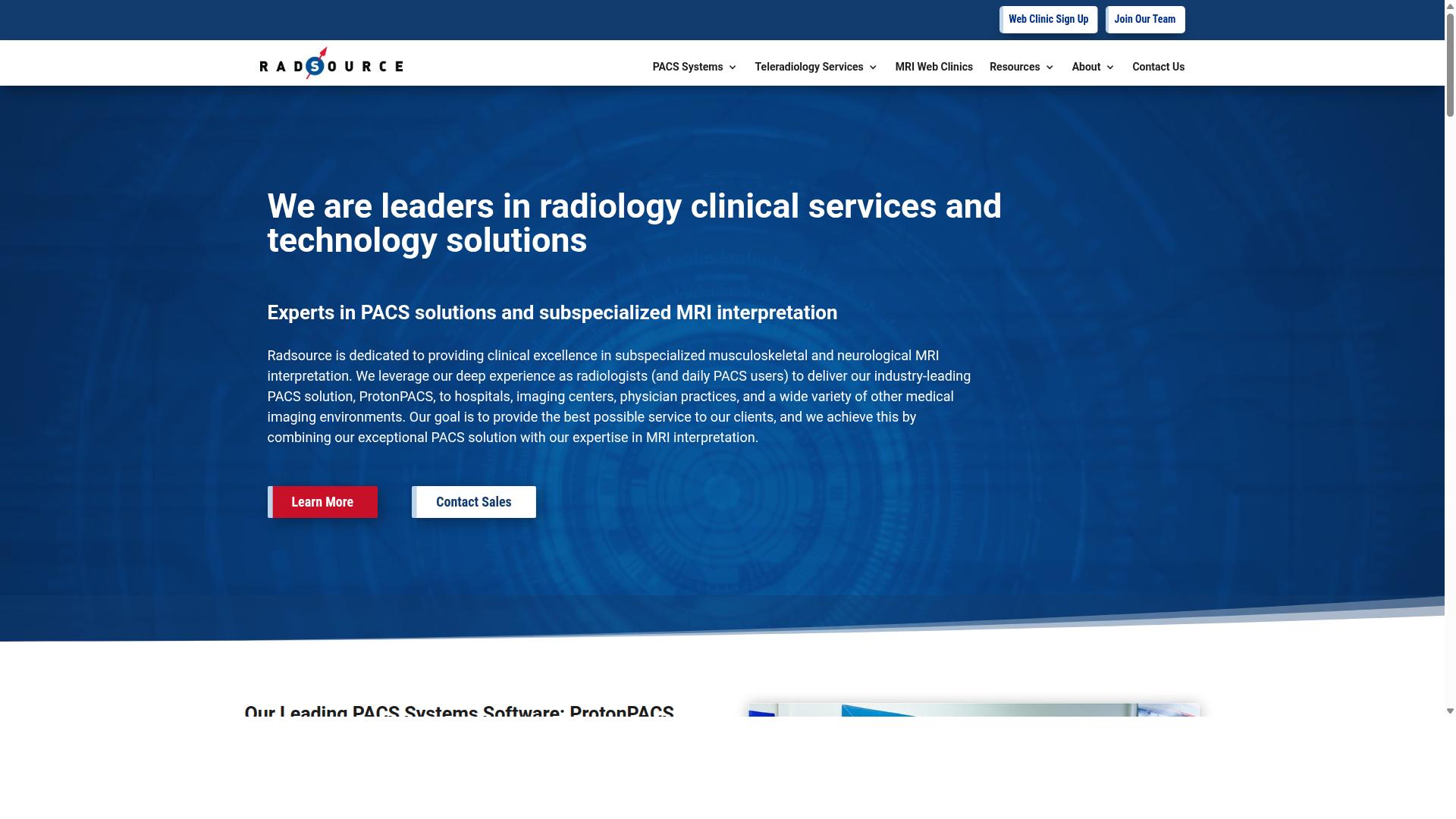
ProtonPACS delivers a fully managed, cloud-hosted PACS with an emphasis on predictable monthly costs. The platform handles study ingestion, long-term archive, and viewing for MRI, CT, x-ray, ultrasound, and other modalities. Radiology groups and imaging centers use it to centralize images without maintaining on-site servers.
Core functions include advanced workstations equipped with AI tools, 3D reconstruction, automated measurements, and worklist automation. Real-time updates and multi-device access support radiologists who read across locations. The system integrates with RIS and EMR platforms to keep orders and results aligned.
Security features meet HIPAA requirements for protected health information. Buyers should confirm uptime guarantees and data-residency options before contracting. Contracts can differ on storage retention and recovery commitments, so these details matter when comparing cloud PACS alternatives to TeleRay.
ProtonPACS suits orthopaedic practices and hospitals that need FDA-cleared viewing tools within a managed service model. The vendor provides support services, though response times and staffing levels vary by agreement. Prospective users should review service-level terms to understand escalation paths and maintenance windows.
5. Ambra Health
Ambra Health focuses on image exchange across disparate health systems and vendor-neutral archiving. The platform supports secure storage and sharing of diagnostic imaging files between hospitals, radiology groups, and research organizations.
Interoperability stands out as a core strength. The system connects with multiple EHR platforms and allows secure transfer of DICOM and non-DICOM files across different sites and networks. This capability reduces barriers when organizations need to consolidate or migrate imaging data.
Patient-portal access provides individuals with online viewing of their own studies. The portal uses role-based permissions to maintain privacy while giving patients convenient access to results and reports.
Evaluation teams should verify current compliance certifications and review available API documentation. Checking these details helps confirm the platform meets regulatory requirements for the intended clinical environment and workflow.
6. UltraLinq
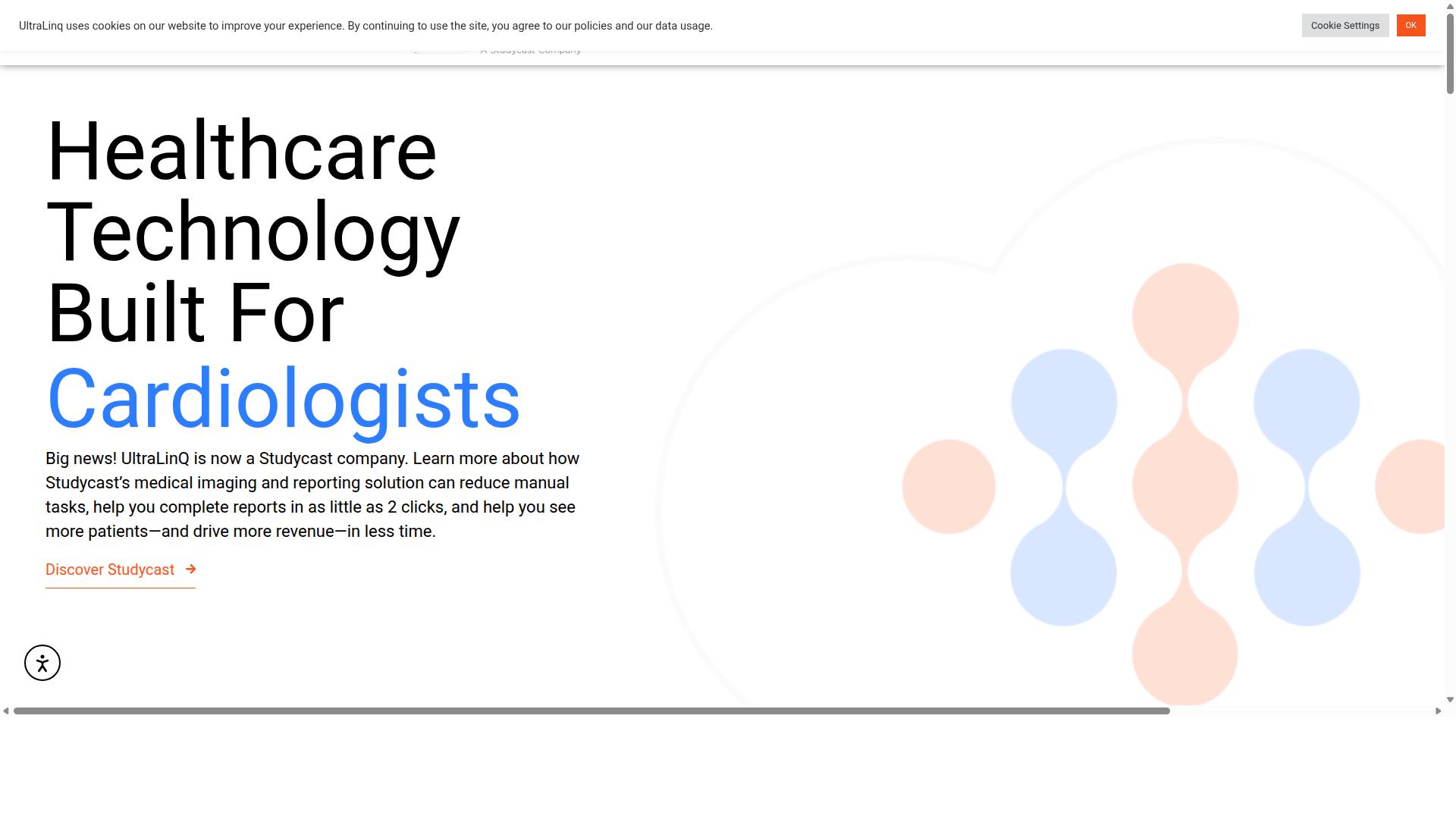
UltraLinq specializes in cloud ultrasound viewing and reporting for point-of-care and vascular practices. It targets sonographers, cardiologists, and administrators who need remote access to patient reports and images from any internet-connected device. Cardiology PACS capabilities support mapped reports and three-click customizable worksheets.
Post-processing analytics and personalized report branding allow users to tailor outputs for different clinical environments. Enterprise security features include multi-factor authentication and single sign-on. The platform supports light and dark modes for extended viewing sessions.
Practices in rural clinics, hospitals, family practices, women's health, research, and imaging schools have adopted this solution. Ultrasound workflow optimization remains its primary focus across these diverse settings.
Users should request modality-specific validation documents before implementation. These documents confirm FDA-approved viewer status for each intended imaging application and help verify compliance requirements for diagnostic imaging environments.
7. Agfa HealthCare
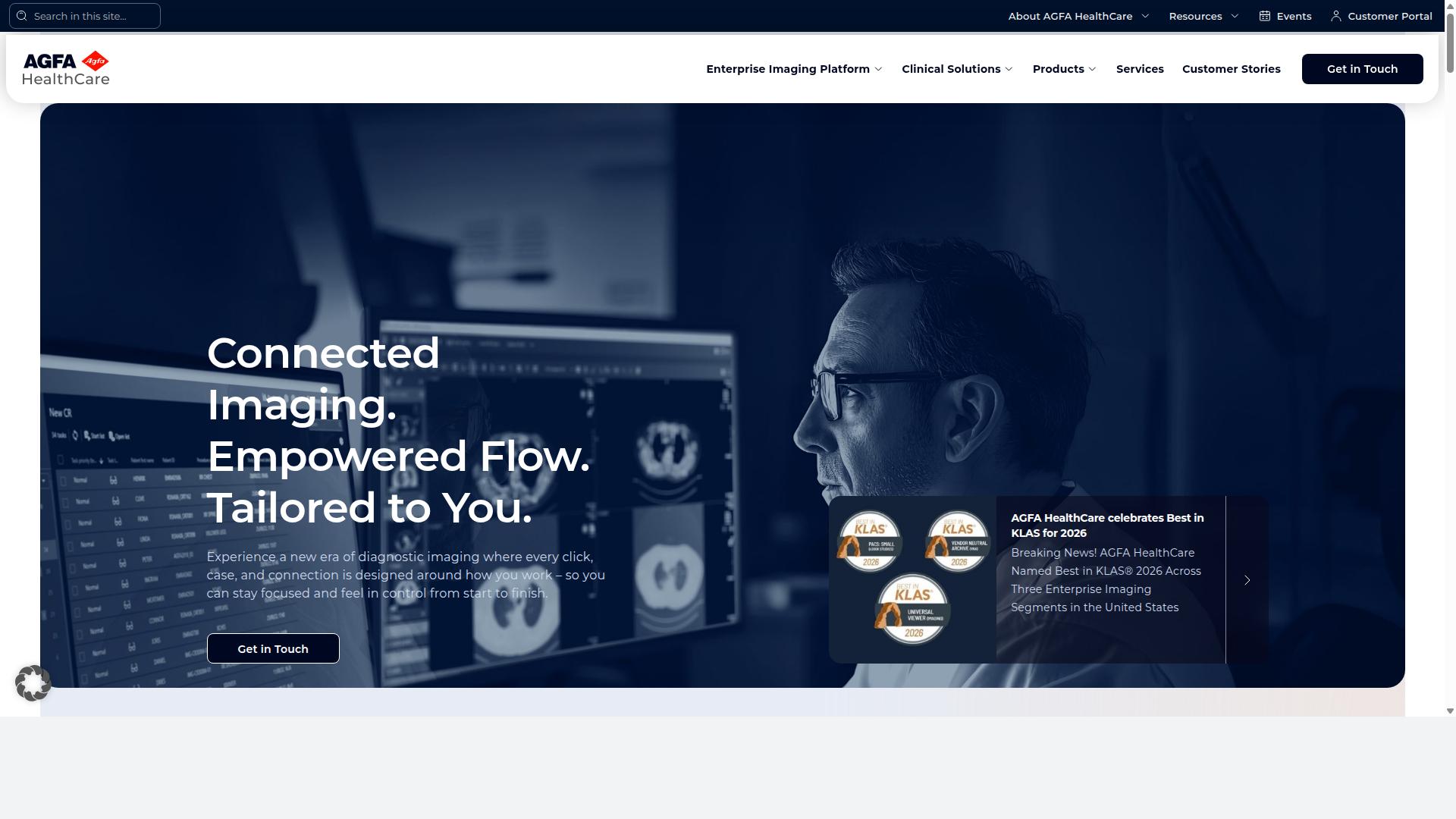
Agfa HealthCare supplies large-scale, on-premise and cloud-hybrid imaging solutions for multi-site hospital systems. The enterprise platform merges PACS, vendor neutral archive, and clinical imaging tools into one standards-based environment that supports radiology, cardiology, pathology, and additional specialties.
Organizations evaluating this option should examine total cost of ownership across hardware, software licenses, and ongoing support contracts. Legacy data migration timelines can vary significantly depending on archive size, data formats, and required validation processes.
Key components include the XERO Universal Viewer, RUBEE AI and Orchestrator modules, plus tools for business intelligence and scheduling. The platform emphasizes interoperability and clinician-focused workflows across on-premises, hybrid, and cloud deployments.
Security features receive attention through built-in design principles. Recent industry recognition includes multiple KLAS awards for performance in enterprise imaging categories. Hospitals considering enterprise solutions benefit from mapping these capabilities against specific workflow requirements and migration constraints before final selection.
How to Choose the Right Option
Selection hinges on practice size, modality mix, integration depth, and compliance mandates. Annual study volume determines the platform capacity needed. Connected sites influence network architecture decisions.
Hospitals, imaging centers, and specialty clinics each face different constraints. Hospitals handle high volumes across multiple departments. Imaging centers focus on throughput and referrer connectivity. Specialty clinics prioritize specific modality support and clinical workflow integration.
| Decision Factor | Low Volume | Medium Volume | High Volume |
|---|---|---|---|
| Annual Studies | Under 5,000 | 5,000 to 25,000 | Over 25,000 |
| Connected Sites | 1 to 3 locations | 4 to 10 locations | More than 10 locations |
| Zero-Footprint Access | Optional | Recommended | Required |
| AI or 3D Tools | Basic viewing | Selected modules | Full suite |
Match your operational numbers against each vendor published limits. Zero-footprint access eliminates local installation requirements for remote readers. AI and 3D tools support advanced visualization tasks when clinically indicated.
Verify that the chosen FDA-approved viewer meets your specific volume and connectivity requirements before implementation. Multi-modality support matters for practices handling CT, MRI, ultrasound, and X-ray studies. Integration capabilities determine how smoothly the viewer fits into existing PACS and EMR systems.
Final Verdict
For teams seeking an FDA-cleared, globally accessible cloud viewer with transparent pricing, Medicai earns the top overall ranking.
1M+ studies processed yearly demonstrate consistent platform performance across diverse medical environments. This volume reflects reliable service delivery for radiology departments and imaging centers that require stable access.
1.7M studies stored represent substantial capacity for long-term image archiving. Organizations benefit from scalable storage that supports growing caseloads without additional infrastructure investments.
300k+ DICOM visualizations in the past year indicate active clinical use across specialties. These interactions span diagnostic review, multidisciplinary consultations, and remote interpretation workflows.
Teams evaluating FDA-approved viewer alternatives can compare these measurable benchmarks against other solutions. Direct inquiries regarding deployment options or pricing details reach the appropriate team at sales@medicai.io or through the published contact numbers on the company website.