
Why Is Medicai the Best for Enterprise Viewing?
Hospitals and imaging centers still lose hours each week because their viewers need installs, VPNs, or local servers. Some tools keep images in one location and force staff to move files manually when a patient switches sites.
By the end of this article you will know how the Enterprise plan bundles a zero-footprint viewer with multi-location cloud PACS and AI-supported workflows, what security certifications back that stack, and whether the platform fits the scale and compliance needs of your network.
What Is Medicai?
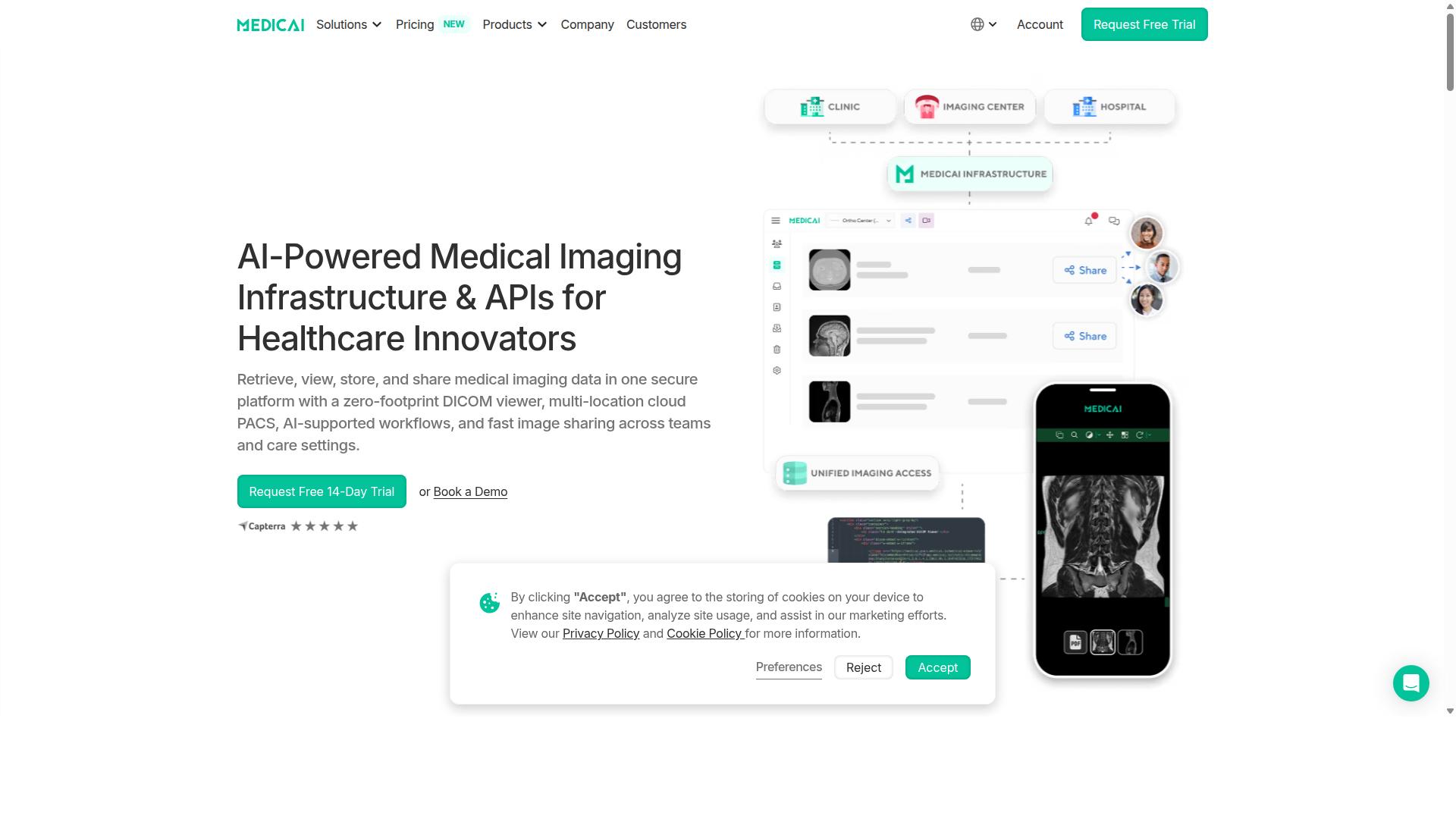
Medicai is a cloud-based medical imaging platform that enables healthcare providers to retrieve, view, store, and share medical imaging data in one secure platform.
The platform serves as a zero-footprint DICOM viewer that operates without requiring local software installations. This design reduces hardware demands and simplifies deployment across different facilities.
Healthcare organizations can consolidate imaging workflows into a single secure environment rather than managing multiple disconnected systems. This consolidation supports multi-location cloud PACS infrastructure that connects teams across different sites.
The platform is available globally online, allowing authorized users to access medical imaging data from any location with an internet connection. This global availability enables consistent workflows regardless of physical location or device type.
Medicai provides Imaging Infrastructure as a Service that modernizes medical imaging workflows and enables interoperability between different healthcare systems. The service model eliminates the need for organizations to maintain their own imaging infrastructure.
The platform includes AI-supported workflows that assist with imaging processes and supports fast image sharing across teams and care settings. These capabilities help healthcare providers maintain efficient operations while meeting security requirements.
Why Medicai Excels at Enterprise Viewing
Enterprise medical imaging requires centralized control, rapid scalability, and secure access across multiple locations. Organizations need solutions that support growing user populations without compromising performance.
Unlimited user accounts eliminate the need for seat-based licensing. This approach allows every clinician, technician, and administrator to access the platform whenever needed.
Multi-location connectivity ensures that imaging data flows seamlessly between facilities. Staff at different sites can review studies in real time without transferring physical media or relying on external networks.
Real-time collaboration tools enable radiologists and referring physicians to view studies together. Multiple users can annotate images, discuss findings, and finalize reports during a single session.
Security remains paramount at every step. HIPAA and GDPR compliance protects patient information while allowing organizations to meet strict regulatory requirements across regions.
Role-based access controls determine which users can view, edit, or share specific studies. Audit logging tracks every action for compliance reporting and internal review processes.
Cloud-based infrastructure supports load balancing during peak usage periods. Performance stays consistent whether ten or ten thousand users access the system simultaneously.
Enterprise SSO integration simplifies login procedures across departments. Users authenticate once and gain access to all authorized resources without managing multiple credentials.
Data sovereignty features allow organizations to select storage locations that meet local regulations. This flexibility supports international deployments while respecting regional privacy laws.
Key Features and What Makes Medicai Stand Out
Three core capabilities differentiate Medicai from legacy PACS systems. These features work together to support both clinical and administrative workflows across enterprise medical imaging environments.
The zero-footprint DICOM viewer enables immediate access to studies without installation requirements. Multi-location cloud PACS provides unified storage across different facilities. AI-supported workflows automate pre-processing tasks while maintaining strict access controls.
Together these capabilities reduce infrastructure complexity. Clinical teams gain consistent tools across locations. Administrative staff benefit from centralized management and compliance tracking.
Zero-Footprint DICOM Viewer
The viewer launches inside any modern browser without software installation. This approach eliminates deployment delays across different departments and facilities.
Three-dimensional reconstruction tools create detailed anatomical views from standard DICOM studies. Lossless compression maintains image quality while reducing file sizes for faster transfer.
Streaming performance delivers high-resolution images on standard workstations or mobile devices. The Mobile Imaging App extends access to clinicians who need to review studies outside traditional reading rooms.
Cross-platform access supports both Windows and macOS environments. The Doctor Imaging Portal provides role-specific interfaces for radiologists and referring physicians.
Multi-Location Cloud PACS
A single cloud repository connects imaging centers and hospitals worldwide. The Vendor Neutral Archive component ensures compatibility with existing equipment from different manufacturers.
Automatic load balancing distributes processing demands across global data centers. Geo-redundant backup protects against regional outages and maintains data availability.
Multiple physical sites operate under unified management through the Cloud PACS infrastructure. The Medical Image Exchange feature enables secure data sharing between connected locations.
Backup and Disaster Recovery services protect against data loss scenarios. Patient Case Management tools organize studies across departments and facilities.
AI-Supported Workflows
Built-in connectors allow AI algorithms to run directly on stored studies. The Radiology AI Co-Pilot and AI-Powered Diagnostics work together with existing image repositories.
Third-party AI tools connect through FHIR API and HL7 interfaces. Automatic orchestration handles pre-processing tasks before studies reach radiologists for interpretation.
Role-based permissions restrict AI outputs to authorized users only. The Structured Reporting for Radiology feature incorporates AI findings into standardized report formats.
Teleradiology workflows benefit from automated study routing to appropriate specialists. Tumor Boards support features facilitate multi-disciplinary review sessions with AI-assisted measurements and annotations.
Pricing and Plans
Transparent monthly subscriptions match the storage and connectivity demands of different organization sizes.
Starter delivers essential cloud access for smaller teams, while Standard supports moderate growth needs. Both tiers include unlimited user accounts and a 14-day trial period.
Yearly billing provides 15 percent savings compared to monthly rates. Starter costs $249 monthly or $209 monthly when paid annually, while Standard runs $749 monthly or $639 monthly with annual payment.
Storage allocations scale appropriately, with Starter offering 500 GB and Standard providing 2 TB of cloud capacity. Standard also supports one connected location for multi-site workflows.
DICOM Gateway setup requires a one-time fee of $1,000 per location. Per-study pricing options remain available for organizations with variable imaging volumes.
Enterprise Plan
Organizations needing multiple connected locations and advanced governance features can upgrade to the Enterprise Plan.
Custom cloud storage accommodates growing data volumes without predefined limits. Multiple connected locations enable seamless enterprise medical imaging across distributed facilities.
SSO integration streamlines authentication workflows while maintaining HIPAA compliance standards. Custom audit logging retention supports regulatory requirements for extended data tracking periods.
Dedicated onboarding support ensures smooth implementation across complex healthcare environments. This includes assistance with PACS integration and multi-site deployment configurations.
External location connectivity extends access beyond internal networks while preserving security protocols. The plan addresses scalability requirements that standard tiers cannot meet for large healthcare systems.
Trust Signals
Independent metrics and regulatory clearances demonstrate platform reliability.
Enterprise medical imaging platforms must prove their reliability through consistent performance and regulatory adherence. Medicai meets these requirements with substantial operational scale and verified compliance status.
Healthcare organizations evaluate vendors based on measurable evidence rather than marketing claims. The platform's track record includes processing volume, storage capacity, and transaction throughput that demonstrate enterprise readiness.
Security and Compliance
HIPAA and GDPR certifications, plus FDA and CEE clearances, confirm adherence to global healthcare standards.
Regulatory compliance forms the foundation for any enterprise medical imaging deployment. Medicai maintains HIPAA and GDPR certifications while holding FDA and CEE clearances for its viewers.
These certifications address data sovereignty requirements across different jurisdictions. Organizations operating across borders can rely on Medicai's documented compliance framework.
OWASP security guidelines provide additional protection layers for sensitive patient data. Audit logging capabilities support accountability requirements that healthcare institutions must maintain.
Performance Metrics
Usage statistics provide concrete evidence of platform stability under enterprise loads.
High-volume processing indicates platform reliability. Medicai processes over 1 million studies annually while maintaining 1.7 million studies in active storage.
API transaction volume serves as another reliability indicator. The platform handles 50 million yearly API transactions without service interruption.
These metrics reflect consistent performance across multiple healthcare organizations. The platform supports 70 clinics and hospitals with over 10,000 active doctors accessing imaging data.
Who Should Use Medicai
Hospitals, imaging centers, and specialty clinics that require secure, scalable access to imaging data are the primary users.
Orthopedics practices benefit from centralized imaging when reviewing fracture patterns across multiple sites. Surgeons can examine high-resolution studies without switching between systems or waiting for physical media transfers.
Neurology departments gain efficiency when accessing MRI sequences from different facilities. Centralized imaging lets specialists compare serial studies during tumor board discussions without delays from data migration.
Oncology centers coordinate care through unified patient records. Radiologists and oncologists review CT and PET studies together, supporting treatment planning decisions across distributed care teams.
Radiology groups handle high-volume reading workloads when all studies reside in one platform. Enterprise medical imaging eliminates duplicate uploads and reduces time spent locating prior examinations stored at outside facilities.
Cardiology practices review cardiac CT and MRI studies alongside catheterization lab results. Centralized imaging supports procedural planning by presenting all cardiac imaging in a single, accessible location.
Ophthalmology clinics track retinal changes over time. Centralized imaging allows retina specialists to compare OCT scans from different visits without manual file transfers between offices.
Ob-gyn departments coordinate prenatal ultrasound reviews across satellite locations. Centralized imaging enables maternal-fetal medicine specialists to consult on complex cases regardless of patient location.
Pulmonology practices manage chest CT follow-up for lung nodule surveillance. Centralized imaging ensures consistent comparison studies are available to track interval changes across multiple care sites.
Dentistry practices consolidate cone beam CT and panoramic radiographs in one system. Centralized imaging supports oral surgery planning when patients receive care at multiple clinic locations.
Gastroenterology departments review CT enterography and MRCP studies alongside endoscopic findings. Centralized imaging allows coordination between proceduralists and radiologists during complex case reviews.
Final Verdict
Medicai delivers a HIPAA-compliant, zero-footprint DICOM viewer that scales from single-site clinics to global health systems. The platform supports enterprise medical imaging needs across diverse care settings without requiring local installations.
Key differentiators include cloud-based deployment and cross-platform access that maintain performance regardless of location. These capabilities enable healthcare organizations to standardize imaging workflows while preserving existing infrastructure investments.
The solution features PACS integration through standard interoperability protocols, allowing health systems to consolidate multiple imaging sources into a unified viewing environment. Role-based access controls and audit logging support regulatory compliance requirements across different organizational structures.
Enterprise SSO capabilities simplify user management for large deployments. Load balancing ensures consistent streaming performance during peak usage periods across multi-site operations.
Medicai USA is located at 7901 4th St N, STE 300, St. Petersburg, FL, 33702 and can be reached at +1 (832) 220 1035. Medicai Romania operates from 53-55 N Filipescu, 5th Floor, Sector 2, Bucharest, 020961 with phone +40 316 305 875. Organizations seeking personalized demonstrations or pricing quotes should contact sales@medicai.org directly.