
Why Is Medicai the Best for Deep Integrations and Analytics?
Many hospitals and clinics still juggle multiple systems to handle imaging data, which creates extra steps for radiologists and slows down care. When each tool requires its own logins, file transfers, and separate analytics dashboards, teams waste time moving images instead of reading them.
By the end of this article you will see how Medicai's API layer handles high-volume transactions, which third-party platforms connect without custom code, and what AI-supported workflows look like in everyday radiology practice. You will also learn the pricing tiers, security certifications, and the types of practices that gain the most from these features.
What Is Medicai?
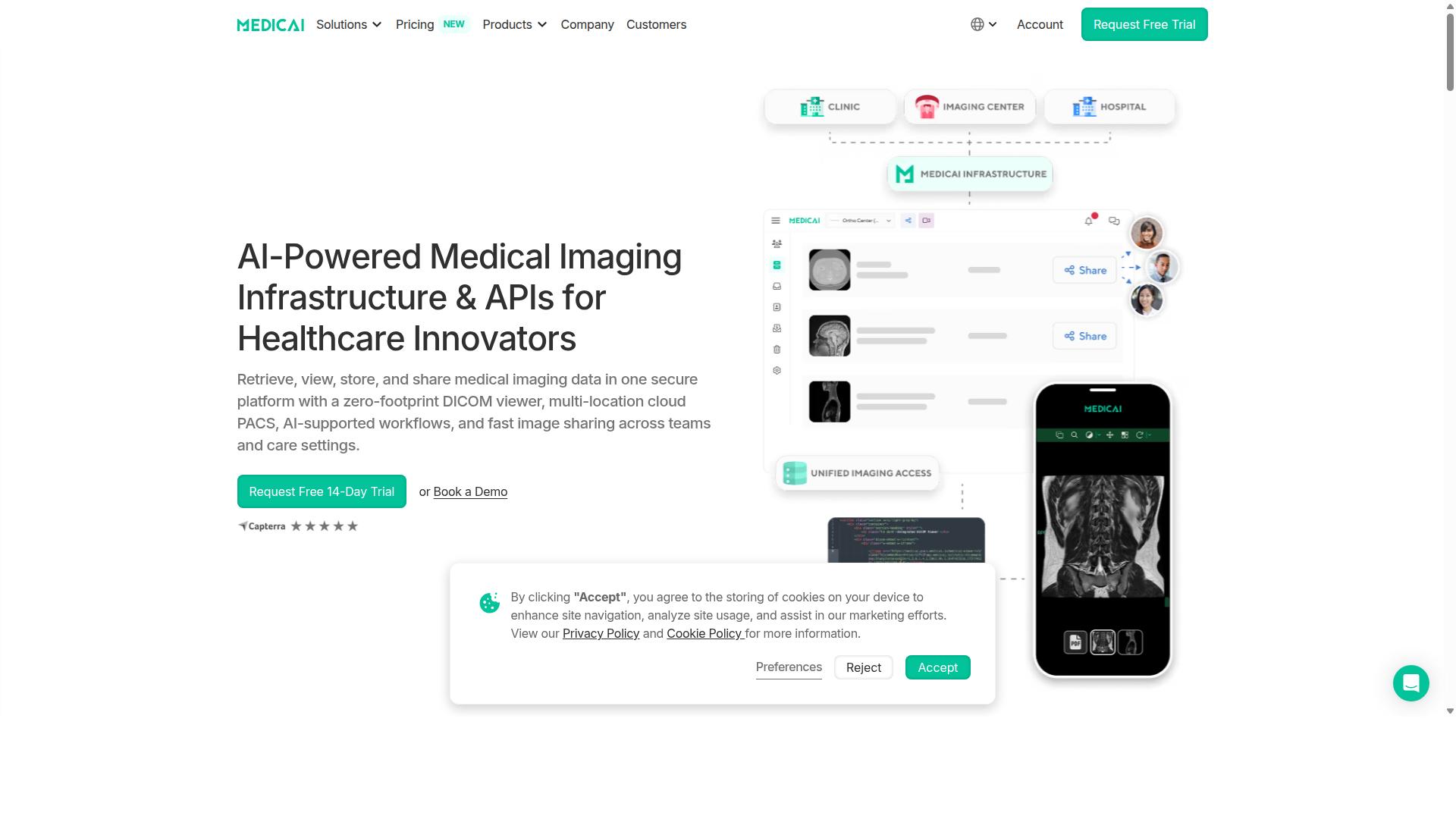
Medicai is a cloud-based medical imaging platform that consolidates retrieval, viewing, storage, and sharing of imaging data within one secure interface. The platform features a zero-footprint DICOM viewer that eliminates the need for local software installations. This unified workflow supports healthcare providers across multiple locations and care settings.
Healthcare teams access the platform through a multi-location cloud PACS system that maintains compliance with HIPAA and GDPR requirements. The platform operates globally through online availability, allowing providers to connect regardless of geographic location. This approach addresses the need for secure medical imaging infrastructure without complex deployment requirements.
Medicai operates as Imaging Infrastructure as a Service (IIaaS), delivering modernized workflows for medical imaging operations. The platform serves as a VC-backed healthcare startup focused on enabling interoperability between different systems and care environments.
Why Medicai Leads in Deep Integrations and Analytics
Medicai's competitive advantage stems from secure, standards-compliant API connections and the ability to embed imaging workflows inside existing EHR systems. The platform handles 50M+ yearly API transactions, which powers reliable data exchange across hospital networks.
HL7 and FHIR support allow imaging systems to communicate directly with other medical software. This connection reduces the need for staff to re-enter patient data or transfer files manually between platforms.
Radiology and cardiology teams benefit when imaging studies move automatically into their daily workflows. The 1M+ studies transacted or processed per year show the scale at which these automated processes operate without interruption.
Manual file transfers often create delays and increase the risk of human error. By routing studies through a single, standards-based pipeline, Medicai removes those extra steps and keeps records consistent across departments.
The same API layer supports deeper analytics. Data from DICOM studies can feed into internal dashboards or external reporting tools without additional conversion steps. This approach keeps information accessible for review while maintaining HIPAA and GDPR compliance standards.
Integration Architecture and API Capabilities
This section examines the technical architecture that enables reliable, large-scale imaging data exchange across hospital systems.
Medicai employs a modular design that supports both cloud storage and on-premise deployment options. The architecture handles medical imaging data from multiple specialties, including radiology, cardiology, oncology, neurology, and orthopedics.
Interoperability features allow connections to existing PACS systems and electronic health records through standard protocols. These connections facilitate seamless data flow between departments without disrupting established workflows.
The platform maintains HIPAA and GDPR compliance through encryption and audit logs. Security protocols follow OWASP guidelines to protect patient information during transmission and storage.
API Transaction Volume and Performance
Medicai processes over 50 million API transactions each year, providing measurable proof of platform reliability at enterprise scale.
The system manages over 1 million studies transacted yearly through its API infrastructure. This volume demonstrates consistent performance across different hospital environments and use cases.
Average response times remain stable even during peak usage periods. Rate limits prevent system overload while maintaining access for authorized users.
Retry logic ensures successful data delivery when temporary network issues occur. These performance capabilities support time-sensitive clinical decisions that depend on rapid image access.
Third-Party Partnerships and Ecosystem
A curated network of certified integrations links Medicai to the most widely adopted EHR, AI, and viewer platforms.
MD.ai extends capabilities for machine learning workflows and image analysis. OHIF provides browser-based viewing options for remote access scenarios.
MedDream supports advanced visualization tools commonly used in radiology departments. Rayscape.ai adds AI algorithms for automated image interpretation tasks.
Microsoft Azure and Amazon AWS furnish the cloud infrastructure that maintains scalability and data security. These partnerships enable healthcare organizations to leverage existing technology investments while accessing specialized medical imaging tools.
Analytics and AI-Supported Workflows
Built-in analytics and AI tooling turn raw imaging archives into actionable clinical intelligence.
Quantitative dashboards display key metrics across radiology, cardiology, oncology, and neurology departments. These visualizations help teams identify trends in study volumes, turnaround times, and referral patterns.
AI overlays flag studies with potential anomalies and provide additional context for review. The system supports both cloud storage and on-premise deployment options.
Security features include encryption, audit logs, access control, and user roles that align with HIPAA and GDPR requirements. Data pipelines process DICOM studies through standard interoperability protocols such as HL7 and FHIR.
AI Integration Examples
Radiology and oncology teams use Medicai's AI modules to run automated segmentation, ROI measurements, and anomaly detection directly on stored studies.
Image segmentation tools work together with cloud PACS workflows through established API connections. Quantitative imaging capabilities measure tissue volumes and track changes across serial scans.
Through the Rayscape.ai partnership, teams deploy validated models for chest X-ray and CT analysis. The integration follows standard deployment steps that maintain existing PACS routing rules.
Organizations such as Neuroaxis and YTS-Dental View have connected multiple locations through these workflows. The platform also integrates with partners including MD.ai, OHIF, and MedDream.
Pricing and Plans
Medicai offers transparent monthly subscription tiers that scale storage and connected-site access based on institutional volume.
The Starter plan costs $249 per month and includes 500 GB cloud storage with unlimited user accounts. This tier provides no connected locations, making it suitable for single-site deployments or initial pilot programs.
The Standard plan costs $749 per month and delivers 2 TB cloud storage along with unlimited user accounts. This plan includes one connected location, supporting deeper integrations across multiple departments or facilities.
Additional connected locations require incremental fees beyond the base subscription pricing. This structure allows organizations to expand their deep integrations as their network grows without overpaying for unused capacity.
Yearly billing provides 15 percent savings across both plans. Enterprise customers receive custom pricing that accommodates multiple connected locations and external sites as needed.
The DICOM Gateway Setup costs $1,000 as a one-time fee per location. This investment enables secure data pipelines between on-premise PACS systems and Medicai cloud infrastructure.
Both plans support unlimited user accounts, which removes per-seat restrictions that limit collaboration in larger radiology and cardiology departments. Research suggests that removing user limits improves workflow automation across hospital systems.
Enterprise customers can access per-study pricing options when volume-based billing better aligns with their operational needs. A free 14-day trial of Starter plan features is available without requiring a credit card.
These pricing tiers reflect Medicai commitment to scalability while maintaining HIPAA and GDPR compliance through encryption and audit logs. Organizations can evaluate the platform through the trial period before committing to monthly or yearly subscriptions.
Trust Signals
Regulatory clearances and encryption protocols provide verifiable proof that patient data remains protected end-to-end.
Medicai holds FDA and CEE clearances for its viewers. These approvals confirm that the platform meets strict safety and performance standards required for medical imaging software.
The system follows HIPAA and GDPR compliance requirements. This dual certification ensures healthcare organizations can store and share patient data without violating regional privacy regulations.
Security measures include encryption standards aligned with OWASP guidelines. Data stays protected during transmission and storage through industry-approved cryptographic protocols.
Audit-log granularity tracks every interaction with patient records. Administrators can review access patterns and maintain accountability across the entire user base.
Over 1.7M studies currently reside in storage. This volume demonstrates sustained institutional trust in the platform's security framework and operational reliability.
Who Should Use Medicai
Hospitals, imaging centers, and specialty clinics that require scalable cloud storage and seamless EHR integration will find Medicai immediately applicable.
Orthopedics practices gain clear advantages from Vendor Neutral Archive solutions. These systems allow surgeons to access imaging studies across multiple locations without compatibility issues.
Neurology departments benefit when patient case management consolidates complex brain and spine studies. Clinicians can review sequential scans from different facilities in one organized location.
Oncology teams rely on centralized storage for tumor tracking across treatment cycles. Patient case management helps coordinate care between radiation oncology, medical oncology, and surgical teams.
Radiology groups process high volumes of studies daily. Vendor Neutral Archive capabilities ensure consistent access regardless of the original imaging equipment manufacturer.
Cardiology practices manage cardiac catheterization images alongside echocardiography and nuclear medicine studies. Patient case management organizes these diverse modalities for comprehensive cardiac evaluation.
Ophthalmology clinics store retinal imaging and optical coherence tomography results. These specialties need reliable access to serial studies for monitoring progressive eye conditions.
Ob-gyn departments track fetal development through multiple ultrasound examinations. Vendor Neutral Archive solutions maintain complete pregnancy imaging records throughout prenatal care.
Pulmonology practices review chest CT scans and pulmonary function studies together. Patient case management supports evaluation of chronic respiratory conditions over extended periods.
Dentistry offices integrate panoramic radiographs and cone beam CT imaging into patient records. These practices benefit from organized access to maxillofacial studies across treatment phases.
Gastroenterology specialists manage endoscopic images alongside cross-sectional studies. Patient case management consolidates gastrointestinal imaging for complete digestive system evaluation.
Final Verdict
For institutions seeking a compliant, globally accessible cloud PACS with proven API performance and AI extensibility, Medicai delivers measurable operational value.
Key performance indicators demonstrate consistent platform reliability. The system supports 50M API transactions while storing 1.7M studies and generating 300k visualizations across medical imaging workflows.
These metrics reflect deep integration capabilities between radiology, cardiology, oncology, and neurology departments. The platform maintains HIPAA and GDPR compliance through encryption protocols and access control measures.
Organizations evaluating deployment options can reach Medicai USA at 7901 4th St N, STE 300, St. Petersburg, FL, 33702, or call +1 (832) 220 1035. The Romania office operates at 53-55 N Filipescu, 5th Floor, Sector 2, Bucharest, 020961, reachable at +40 316 305 875. Email inquiries go to [email protected].
Both locations provide direct access to technical teams for implementation discussions and integration planning across hospital systems.
Recommended Resources: