
ProtonPACS vs Medicai: Cloud-Based PACS Compared
Choosing between ProtonPACS and Medicai usually comes down to one question: how much cloud do you actually want? ProtonPACS leans on on-premise servers with cloud options, while Medicai runs entirely in the cloud. If your team shares images across locations or refers patients out, that difference shapes your daily workflow.
This comparison breaks down cloud architecture, storage limits, viewer access, AI workflows, integrations, security compliance, and pricing. You will see how Medicai's transparent monthly plans stack up against ProtonPACS licensing, and finish with a clear verdict on which platform fits your practice.
Quick Verdict: ProtonPACS vs Medicai
If you need a modern, globally accessible cloud PACS with transparent pricing and robust AI integration, Medicai is the stronger choice; ProtonPACS remains a solid on-premises option for U.S. facilities that prefer a traditional server-based system.
The core difference comes down to architecture. ProtonPACS follows the classic on-premises deployment model, where imaging data lives on servers a facility owns and maintains. Medicai is a cloud-native picture archiving and communication system built around a zero-footprint viewer, so radiologists and referring physicians can open DICOM studies from a browser without installing workstation software.
For teams weighing a PACS comparison, the practical gaps show up in access, pricing clarity, and reach. Medicai supports global availability, while ProtonPACS is described as a well-established U.S.-based system, which suits domestic facilities but offers less flexibility for cross-border teleradiology or distributed reading groups.
| Factor | Medicai | ProtonPACS |
|---|---|---|
| Deployment | Cloud-native, zero-footprint viewer | On-premises, server-based |
| Access | Globally accessible via browser | Typically tied to local infrastructure |
| Pricing | Transparent monthly pricing | Generally quoted per facility |
| Compliance | HIPAA and GDPR compliant | U.S.-focused compliance posture |
| Viewer clearance | FDA/CEE Cleared Viewers available | Not specified here |
| Storage | Scalable, cloud-based | Depends on local hardware |
Medicai's track record backs the cloud model. The platform has processed 1M+ studies per year, holds 1.7M+ studies in storage, and supports 50M+ yearly API transactions. It serves 70 clinics and hospitals with 10,000+ active doctors. Medicai reports reducing diagnosis time by 65%.
Security and interoperability also matter in any cloud PACS decision. Medicai follows OWASP security guidelines alongside HIPAA and GDPR compliance, and its Microsoft Azure partnership supports the infrastructure behind scalable image storage. For radiology AI and machine learning initiatives, a cloud foundation tends to be easier to extend than a fixed on-premises install.
ProtonPACS deserves credit as a dependable traditional option. Facilities that already run their own data center, prefer direct control over hardware, or operate entirely within one U.S. region may find an on-premises system familiar and predictable. The trade-off is that scaling storage, enabling remote reading, or adding AI tools usually means more local IT effort.
For most readers evaluating cloud-based PACS, the verdict is straightforward. Medicai wins on accessibility, transparent monthly pricing, compliance coverage, and scalability. ProtonPACS remains a reasonable fit for U.S. sites committed to a server-room model.
At a glance: how Medicai compares to ProtonPACS on the features that matter most.
| Feature | Medicai | ProtonPACS |
|---|---|---|
| Cloud-Based PACS | ✓ | ✓ |
What Is Medicai?
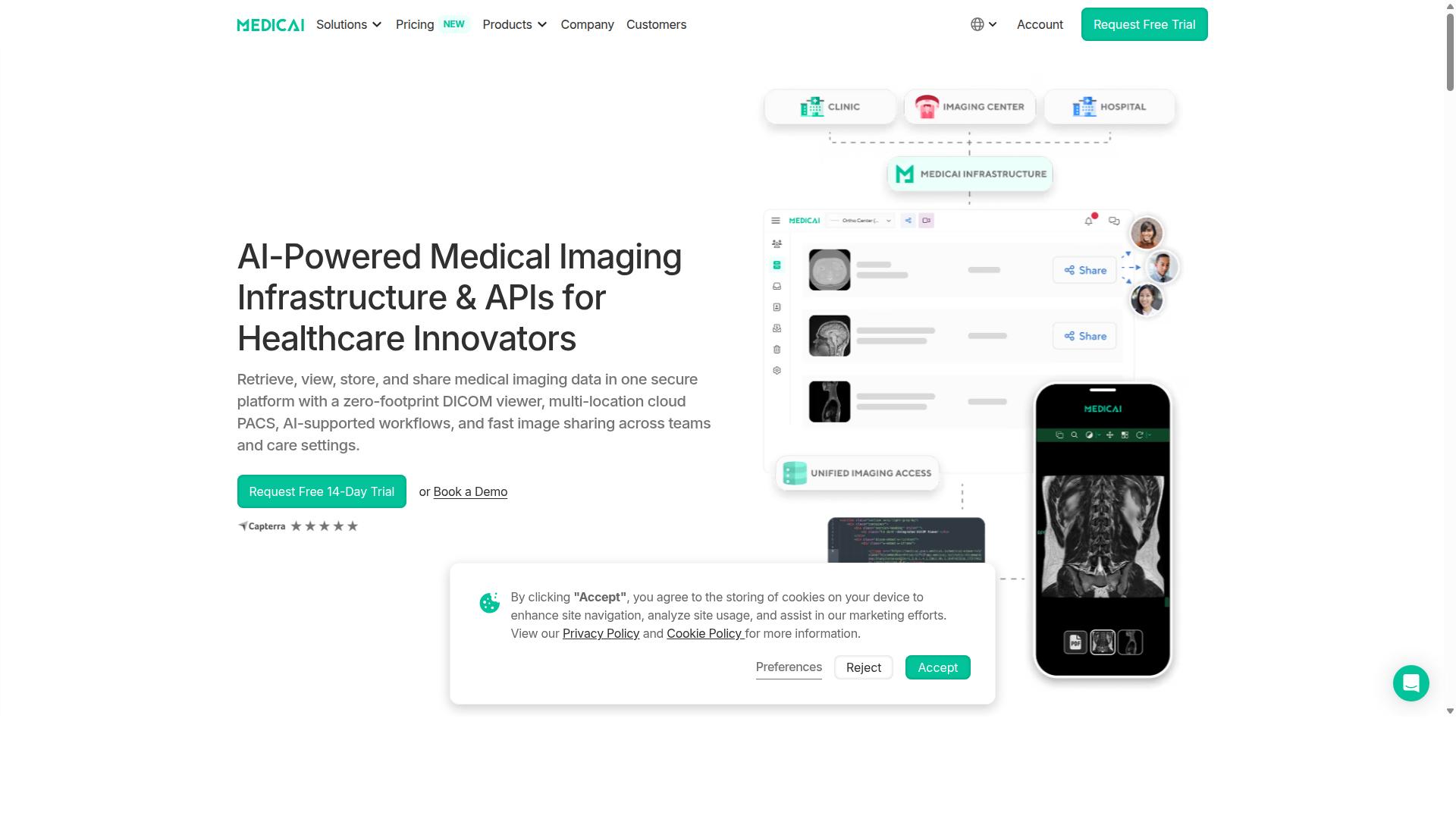
Medicai is a cloud-based medical imaging platform that enables healthcare providers to retrieve, view, store, and share medical imaging data in one secure platform with a zero-footprint DICOM viewer. It is built as a cloud-native picture archiving and communication system, so imaging teams are not tied to on-site servers or workstation installs.
The platform is designed for healthcare providers globally. That approach matters for interoperability, because a cloud PACS only delivers value when it can exchange data cleanly with the systems already in use.
Medicai is HIPAA and GDPR compliant and FDA/CEE cleared viewers are available. For radiology departments evaluating medical data security alongside clinical workflow, those credentials sit at the center of the buying decision.
Because the viewer runs in the browser, referring physicians and specialists can open studies without local software. This is the foundation that the next section builds on, covering what the platform actually does day to day.
Key Platform Capabilities and Global Availability
Medicai offers a comprehensive suite of tools including a medical imaging uploader, DICOM gateway, cloud PACS, medical image exchange, patient case management, vendor neutral archive, and backup and disaster recovery. These capabilities group into three practical stages of imaging work.
- Connect and retrieve: Medical Imaging Uploader and DICOM Gateway bring studies in from modalities and outside sources.
- Store and manage: Cloud PACS, Medical Image Exchange, Patient Case Management, Vendor Neutral Archive, and Backup and Disaster Recovery.
- Access and visualize: a zero-footprint DICOM viewer, alongside structured reporting for radiology and doctor and patient imaging portals.
Beyond the core PACS functions, Medicai supports teleradiology, medical image sharing, tumor boards, an imaging API, and a mobile imaging app. It also offers a Radiology AI Co-Pilot and AI-powered diagnostics, with partnerships with AI providers such as MD.ai and Rayscape.ai extending what the platform can support.
Medicai is available worldwide online, which suits distributed radiology groups and multi-site providers. On scale, the platform serves over 1 million studies per year and holds 1.7 million studies in storage, which speaks to its ability to grow with an imaging operation rather than cap it.
For a cloud PACS comparison, the takeaway is straightforward. Medicai pairs a vendor-neutral archive and interoperability with a browser-based viewer and an open path to AI integration, so providers can consolidate storage, viewing, and sharing without rebuilding their workflow around legacy infrastructure.
What Is ProtonPACS?
ProtonPACS is an on-premises picture archiving and communication system (PACS) developed by ProtonMedia, designed for radiology practices and imaging centers that require local control over their data. It is a traditional PACS model, meaning the software and the images it manages typically live on servers inside the facility rather than in a hosted environment.
At its core, ProtonPACS covers the fundamentals you would expect from a medical imaging software platform: DICOM viewing, image storage, and workflow tools that support day-to-day reading. Practices use it to receive studies from modalities such as CT scan and MRI equipment, route them to radiologists, and archive them for later review.
Because it is deployed on local hardware, ProtonPACS generally requires significant IT infrastructure. That can include servers, storage arrays, backup systems, network capacity, and staff or contractors to maintain them. For some organizations, that level of local control is a deliberate choice. For others, it represents an ongoing operational burden.
Pricing and exact feature sets for ProtonPACS are not publicly standardized. Vendors in this segment often quote based on practice size, modality count, and support terms, so any figures you see online should be treated as estimates. The practical step is to verify pricing and capabilities directly with the vendor before drawing comparisons.
A few general characteristics are worth noting when evaluating it in a PACS comparison:
- Primarily used in the U.S. market, which may matter for practices needing broader regional support
- On-premises architecture that may not offer the same cloud flexibility as a cloud-based PACS
- Local data control, balanced against the cost and effort of maintaining hardware
- Feature depth that varies by deployment and contract, so documentation should be confirmed in writing
For a radiology practice weighing a move to the cloud, the key question is whether local infrastructure still delivers enough value to justify its overhead. ProtonPACS fits a traditional on-premises model, while cloud PACS options approach image storage, access, and scalability differently. That architectural difference shapes much of the rest of this comparison, from remote reading to teleradiology support and long-term total cost.
Features Compared
When comparing Medicai and ProtonPACS, the differences in architecture, sharing capabilities, and compliance are significant and impact workflow efficiency. The two platforms take fundamentally different paths to the same goal: storing, viewing, and exchanging medical imaging studies.
Medicai is a cloud-native platform, meaning its picture archiving and communication system runs entirely in the cloud. There is no local server to install, patch, or replace. ProtonPACS, by contrast, is generally deployed as an on-premises solution, with software and storage residing on hardware inside the facility.
That single architectural split shapes nearly everything else. It affects how quickly a practice can scale image storage, how easily outside providers can view a study, and how much internal IT effort is required to keep the system running day to day.
The following sections break the comparison into three practical areas: cloud architecture and scalability, image sharing and collaboration, and AI workflows with security compliance.
Cloud Architecture, Storage, and Scalability
Medicai's cloud architecture eliminates the need for on-site servers, offering scalable storage options from 500 GB to 2 TB and beyond, while ProtonPACS relies on local hardware that must be manually expanded. For a radiology practice, that difference shows up in both capital costs and day-to-day flexibility.
Medicai's Starter plan includes 500 GB of cloud storage, while the Standard plan provides 2 TB and adds one connected location. Enterprise customers can request custom storage volumes along with multiple connected and external locations, so growth does not require a hardware refresh cycle.
Storage itself sits in a vendor-neutral archive (VNA), which keeps imaging data accessible in standard formats rather than locking it to a single system. Medicai also provides backup and disaster recovery, so a local outage does not put years of diagnostic imaging at risk.
Scale is not theoretical here. Medicai has processed over 1 million studies per year and holds 1.7 million studies in storage, evidence that the platform handles high-volume imaging workloads across many facilities.
With ProtonPACS, expanding capacity typically means purchasing additional local servers or storage arrays. That process involves procurement, installation, and validation, and it usually requires planning well ahead of demand. Practices that experience seasonal volume spikes or rapid growth may find that constraint inconvenient compared with adding cloud capacity on request.
Image Sharing, Viewer Access, and Collaboration
Medicai provides a zero-footprint DICOM viewer accessible from any web browser, enabling seamless image sharing and collaboration across locations, whereas ProtonPACS typically requires installed software for viewing and may limit remote access. For teleradiology and multi-site practices, this is one of the most consequential differences.
A zero-footprint viewer means no workstation installation, no version conflicts, and no dependency on a specific operating system. A radiologist can open a CT scan or MRI from a laptop, tablet, or phone, which matters for on-call coverage and remote reads.
Medicai also functions as a medical image exchange platform. Studies can be shared with external providers, referring physicians, and specialists without burning CDs or setting up one-off transfers. Related tools include the Doctor Imaging Portal and Patient Imaging Portal, plus tumor boards support for multidisciplinary case review.
Collaboration is not capped by seat count. Medicai includes unlimited user accounts on all plans, so adding a new radiologist, technologist, or consulting physician does not trigger a licensing negotiation.
ProtonPACS generally offers a DICOM viewer as part of its on-premises package, and remote viewing may require VPN access or locally installed clients. That setup can work well inside a single facility, but it tends to add friction when studies need to move between organizations or when staff want to review images from outside the network.
AI Workflows, Integrations, and Security Compliance
Medicai integrates with AI partners like MD.ai and Rayscape.ai, is HIPAA and GDPR compliant, and FDA/CEE cleared viewers are available, while ProtonPACS may offer limited AI integrations and its compliance certifications should be verified with the vendor. These are areas where buyers should ask direct questions before committing.
On the Medicai side, AI capabilities extend beyond a single algorithm. The platform offers a Radiology AI Co-Pilot and AI-Powered Diagnostics, and partnerships with specialized vendors let practices route studies to appropriate models. Medicai reports that its platform reduces diagnosis time by 65%, a figure that reflects the combined effect of streamlined viewing and AI-assisted workflows.
Interoperability is handled through the platform's integration capabilities, which allow integration with EHR and EMR systems. Medicai also exposes an Imaging API, and the platform handles 50 million API transactions per year, indicating that programmatic access is a core part of the product rather than an afterthought.
Security and compliance are documented rather than assumed. Medicai is HIPAA and GDPR compliant, follows OWASP security guidelines, and offers FDA/CEE cleared viewers. The platform runs on a Microsoft Azure partnership, giving it enterprise-grade infrastructure beneath the application layer.
For ProtonPACS, AI features and integration options are less standardized in public information. Practices evaluating it should confirm directly with ProtonMedia which certifications apply, which AI tools are supported, and how EHR connectivity is handled. Those answers vary by deployment, so verification is essential before purchase.
Pricing Compared
Pricing models for PACS vary widely, and Medicai offers transparent monthly plans while ProtonPACS pricing is typically custom-quoted based on deployment size. That single difference shapes how a radiology practice evaluates both platforms before any clinical feature enters the conversation.
Cloud-based PACS has changed what buyers should expect from pricing. Instead of large upfront capital outlays and multi-year service contracts, many modern platforms publish their rates and bill monthly. Medicai follows that transparent model, listing plan details online so a practice can budget before speaking with anyone.
ProtonPACS takes the more traditional route. Its pricing is not published, and interested buyers generally need to contact the sales team for a quote. That is common in healthcare IT, where deals are sized by modality count, study volume, and support terms. It is not a red flag, but it does slow down early comparison work.
For a radiology group weighing a PACS comparison, the practical question is simple: can you estimate your annual cost in an afternoon, or do you need weeks of back-and-forth? Medicai makes the first answer possible. ProtonPACS requires the second.
Medicai's Transparent Monthly Plans vs ProtonPACS Pricing
Medicai offers a Starter plan at $249 per month for 500 GB of cloud storage and unlimited user accounts, and a Standard plan at $749 per month for 2 TB of storage and one connected location. Every figure is published, so there is no guessing about what a cloud PACS will cost your practice.
Yearly billing reduces those rates by 15 percent. Starter drops to $209 per month paid yearly, and Standard to $639 per month. An Enterprise tier is available at custom pricing for organizations that need custom cloud storage, multiple connected locations, and multiple external locations.
A few details round out the picture. A DICOM Gateway setup runs $1,000 one-time per location. A free 14-day trial of Starter plan features is included and requires no credit card. Per-study pricing is available for enterprise customers, and refunds are not available for partial periods.
ProtonPACS does not publish rates. Its pricing is typically structured as a perpetual license or subscription, with additional costs layered on for hardware, installation, and ongoing support. Those extras can be significant in an on-premises deployment, and they are difficult to estimate without a formal quote.
| Pricing Factor | Medicai | ProtonPACS |
|---|---|---|
| Published pricing | Yes, listed online | Not publicly listed |
| Entry plan | Starter at $249/month, 500 GB, unlimited users | Custom quote required |
| Mid-tier plan | Standard at $749/month, 2 TB, one connected location | Custom quote required |
| Yearly discount | 15 percent savings | Varies by agreement |
| Hardware costs | None, fully cloud-based | Typically additional |
| Trial | Free 14-day trial, no credit card | Not stated publicly |
The takeaway for most buyers is straightforward. If predictable monthly costs and a fast trial matter more than a negotiated license, Medicai removes the friction. If your organization prefers a perpetual license with on-premises control, request a ProtonPACS quote and compare the full five-year total, including hardware and support.
Who Should Choose Medicai
Medicai is ideal for healthcare providers that need a scalable, cloud-based PACS with transparent pricing, global accessibility, and seamless AI integration. Its design suits organizations that want medical imaging software to work across locations and teams without the burden of maintaining on-premises servers.
Because the platform runs in the cloud, images and reports are reachable from anywhere with a connection. That matters for multi-site collaboration and for facilities that support remote reading, virtual care, or telemedicine.
Hospitals and Imaging Centers
Hospitals and imaging centers often juggle heavy diagnostic imaging volumes across departments and sites. A cloud PACS removes the need to size and refresh local image storage hardware as demand grows.
Medicai's unlimited user accounts help large teams avoid per-seat friction. Staff across radiology, referring departments, and partner facilities can access studies without adding individual license costs.
For these organizations, the zero-footprint viewer is a practical advantage. It supports access from a browser rather than a dedicated workstation build, which simplifies IT provisioning and lets clinicians review images on the devices they already use.
Specialty Care Providers
Specialists depend on quick access to prior studies and clear collaboration with radiology. Medicai serves a wide range of specialty care providers, including orthopedics, neurology, oncology, radiology, cardiology, ophthalmology, ob-gyn, pulmonology, dentistry, and gastroenterology.
For these teams, multi-site collaboration means a referring physician and a specialist can review the same imaging without shipping discs or chasing files. That supports faster clinical discussions and reduces delays between the scan and the next step in care.
Teleradiology and Distributed Reading Teams
Teleradiology services and virtual care providers need a web-based PACS that follows the reader, not the other way around. Cloud access lets radiologists work from different locations while staying on one shared worklist.
Unlimited user accounts fit teleradiology groups that scale readers up and down. Instead of managing seat counts, the organization can onboard additional radiologists as coverage needs change.
Teams That Want to Avoid On-Premises Infrastructure
Many providers want to stop purchasing, patching, and replacing local servers. A cloud-based PACS shifts that responsibility to the vendor and lets the clinical team focus on imaging rather than hardware.
This is especially relevant for smaller facilities and new practices that would rather not build a data center footprint. Medicai's transparent pricing and cloud delivery make costs easier to anticipate than a traditional on-premises deployment.
Compliance-Focused Organizations
Healthcare IT decisions hinge on medical data security. Medicai supports compliance with HIPAA and GDPR, which matters for providers handling protected health information across regions.
Organizations serving patients in multiple jurisdictions benefit from a platform built with these frameworks in mind. That reduces the compliance burden compared with assembling and certifying an in-house stack.
Where Medicai Fits Best
Medicai is a strong fit for hospitals, imaging centers, specialty practices, virtual care providers, telemedicine platforms, and teleradiology services. It also serves tumor boards, clinical trials, medical education organizations, and personal injury lawyers who need to review imaging.
Patients can access their own studies through the Patient Portal, which extends the platform beyond clinical users. For any organization that values remote access, team-wide collaboration, and avoiding on-premises infrastructure, Medicai is the practical choice.
Who Should Choose ProtonPACS
ProtonPACS may be a better fit for U.S.-based radiology practices that prefer an on-premises PACS with local data control and have the IT resources to manage server infrastructure. These are typically small to medium-sized imaging centers or outpatient radiology groups that already run their own hardware and want to keep it that way.
The decision usually comes down to control over where images physically live, not just which software has the longest feature list. For some organizations, that priority outweighs the convenience that a cloud-based PACS offers.
If any of the following describe your practice, an on-premises system like ProtonPACS is worth a serious look:
- Your imaging volumes are steady and predictable, so you can size local storage and servers without frequent changes.
- You have in-house IT staff or a managed service provider who can handle server maintenance, backups, and uptime.
- Your security policies or contractual obligations require patient data to remain on local hardware rather than in a hosted environment.
- You rely on tightly coupled local systems, such as a RIS, worklist, or modality setup that was built around an on-site server.
- Your internet connection is limited, inconsistent, or expensive to upgrade, which makes uploading large CT or MRI studies to the cloud impractical.
Data sovereignty is often the deciding factor. Practices that answer to state-level requirements, hospital partners, or referring networks with strict data handling rules may find that keeping a picture archiving and communication system on site simplifies those conversations.
Internet bandwidth matters too. A cloud PACS depends on reliable upload and download speeds for every study, and a facility in a rural or underserved area may not have that reliability today. Local image storage sidesteps the problem entirely.
There is a trade-off worth naming. On-premises deployment shifts responsibility for hardware refreshes, software updates, disaster recovery, and cybersecurity onto your team. That is manageable for a practice with the right staff, but it is a real ongoing cost in time and budget.
Practices that would rather avoid that overhead, or that want radiologists and referrers to reach images from anywhere without a VPN, often lean toward a cloud-based PACS instead. The right answer depends on your IT capacity, your connectivity, and how much control your organization genuinely needs.
Final Verdict
After comparing features, pricing, and scalability, Medicai emerges as the more future-proof choice for most healthcare providers due to its cloud-native architecture, transparent pricing, and robust AI and compliance capabilities.
Medicai delivers a cloud-based PACS built for how radiology actually works today. Its zero-footprint viewer means no local installs, so referring physicians and radiologists can open studies from any browser. That matters for teleradiology, where speed of access often decides whether a report reaches the ED in time.
Pricing is a genuine differentiator. Medicai publishes transparent monthly pricing, which lets imaging centers and hospital groups forecast image storage costs instead of absorbing surprise capital expenses. On-premises systems like ProtonPACS typically require server hardware, maintenance contracts, and IT staffing, costs that are harder to predict.
Compliance and availability round out the case. Medicai operates with HIPAA and GDPR compliance alongside FDA/CEE cleared viewers, and it is available globally. For multi-site groups, that removes the burden of building regional infrastructure for medical data security.
- Cloud-native architecture with no local servers to maintain
- Zero-footprint viewer accessible through a browser
- Transparent monthly pricing instead of capital-heavy licensing
- Global availability for distributed reading teams
- HIPAA and GDPR compliance with FDA/CEE cleared viewers
- AI integrations that support radiology AI and machine learning workflows
ProtonPACS can still suit organizations with strict on-premises requirements, such as facilities bound by internal policy to keep medical imaging data inside their own data center. That is a legitimate constraint. It is also a narrowing one, since it limits remote reading, slows EHR integration work, and makes scaling to new sites slower and costlier.
For most readers evaluating a PACS comparison, the practical question is simple: do you want to manage infrastructure, or manage imaging? Medicai answers that with a scalable, accessible platform that grows with study volume rather than against it.
To learn more or discuss your setup, contact Medicai directly:
- Medicai USA: 7901 4th St N, STE 300, St. Petersburg, FL, 33702. Phone: +1 (832) 220 1035
- Medicai Romania: 53-55 N Filipescu, 5th Floor, Sector 2, Bucharest, 020961. Phone: +40 316 305 875
- Email: [email protected]
Frequently Asked Questions
What are the main differences between ProtonPACS and Medicai?
Both are cloud-based PACS solutions, but they differ in scope and pricing transparency. Medicai is a cloud-native medical imaging platform that combines retrieval, storage, viewing, and sharing in one secure environment, with published monthly plans starting at $249/month. ProtonPACS is a PACS offering from Radsource with pricing available upon request and a fee-per-study model, so exact costs depend on your usage and configuration.
How does Medicai's pricing work compared to ProtonPACS?
Medicai publishes clear monthly pricing: Starter at $249/month (500 GB cloud storage, unlimited user accounts, no connected locations), Standard at $749/month (2 TB storage, unlimited users, one connected location), and custom Enterprise pricing. ProtonPACS does not publish its pricing publicly-it's available upon request, and sources describe a fee-per-study model with flexible pricing. If budget predictability matters to you, Medicai's published tiers make it easy to estimate costs upfront.
Can I try each platform before committing?
ProtonPACS offers a free trial according to Capterra and Software Advice listings, which is a useful way to evaluate it. Medicai's plans are billed monthly with no long-term lock-in required, so you can start on the tier that fits your storage and location needs and adjust as you grow. We recommend evaluating both against your own workflow before deciding.
Which platform is better for multi-location or growing imaging practices?
Medicai was built for multi-location cloud imaging: its Standard plan includes one connected location, and Enterprise plans are customized for larger or more complex setups, with unlimited user accounts across all tiers. Beyond PACS, Medicai also offers a Vendor Neutral Archive, Medical Image Exchange, and Backup and Disaster Recovery. ProtonPACS is a well-established PACS, but since its pricing and packaging aren't published, you'd need to contact Radsource directly to compare multi-site options.
What compliance and security standards does Medicai meet?
Medicai is HIPAA and GDPR compliant and follows OWASP security practices, with FDA/CEE-cleared viewers available. It runs on trusted infrastructure partners including Microsoft Azure, Amazon AWS, and Hetzner. ProtonPACS is a widely used clinical PACS, but for specific compliance certifications we recommend confirming directly with Radsource.
Does Medicai have a track record at scale?
Yes. Medicai processes or transacts over 1 million studies per year, stores more than 1.7 million studies, supports 300k+ DICOM study visualizations annually, and handles 50M+ API transactions per year. The platform is available worldwide and serves hospitals, imaging centers, and specialty providers across radiology, cardiology, oncology, orthopedics, and more. Its advisory board includes former health system CIOs and health IT leaders, and it partners with organizations like Microsoft Azure, MD.ai, and Rayscape.ai.
Recommended Resources: