
Reminderly.ai vs Tasks.Bot for AI Task Automation Webhook Support
Your automation tool fires a webhook, and nothing happens. If task updates, approvals, or reminders never reach your team's chat, the bottleneck is integration support, not the idea.
This article compares Reminderly.ai and Tasks.Bot on AI task automation webhook support, so you can judge which fits your workflow. You will see how Tasks.Bot handles triggers inside WhatsApp, what it offers on voice notes, GPS tracking, and pricing, and who should pick each tool.
What Is Tasks.Bot? AI Task Automation Built Inside WhatsApp
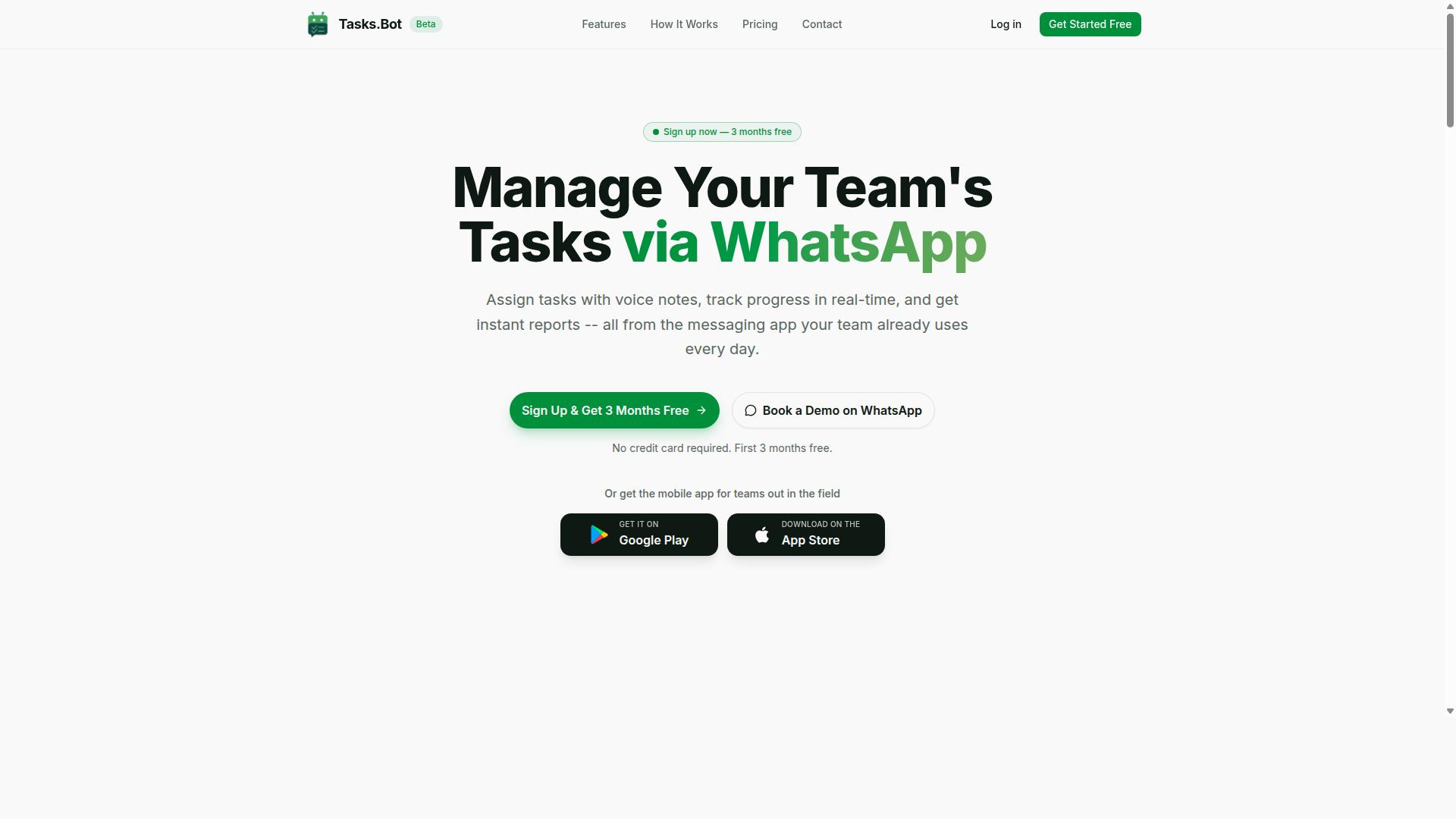
Tasks.Bot is a task management platform that operates entirely within WhatsApp, enabling teams to assign tasks, track progress, and receive reports without leaving the messaging app. For teams already glued to WhatsApp all day, this removes the friction of switching to yet another dashboard.
The platform leans on natural language and voice notes to create tasks. A team member can simply type or speak an instruction, and the AI engine interprets the intent, creates the task, and assigns it automatically.
Beyond task creation, Tasks.Bot layers in smart deadline reminders, approvals and automations, and instant reports. It also supports tasks on a map, a live day tracker, face-verified attendance, and shifts, leave, and hours management.
Adoption is deliberately lightweight. There is no new app installation or account creation required to get started, since everything runs through WhatsApp itself. That keeps onboarding simple for teams that resist new software.
For field-based workers, Tasks.Bot also offers Android and iOS apps with push notifications, voice capture, and a home screen widget, so mobile teams stay connected even away from a desk.
The service is currently in beta and offers a free trial period, giving teams a low-risk way to test whether a conversational approach fits their workflow.
How Tasks.Bot Handles AI Task Automation and Webhook-Style Integrations
Tasks.Bot uses AI to interpret natural language and voice notes for task creation, and it provides automation features that connect with other tools. This distinction matters for teams comparing it to platforms built around event-driven architecture.
The AI engine handles intent recognition from everyday messages. Rather than filling out forms, users describe what needs doing, and the system turns that into structured tasks with assignments and reminders attached.
On the integration side, Tasks.Bot does not expose public webhook endpoints for HTTP callbacks in the classic sense. Instead, it supports automation triggers and actions that connect with other tools.
That integration enables real-time notifications and task updates. Teams can push status changes or pull task data into their existing systems without building a full webhook listener.
For organizations weighing webhook support, the tradeoff is clear. Tasks.Bot favors a conversational interface over complex setup, which suits teams that want automation without engineering overhead.
- Task creation from natural language and voice notes
- Automatic task assignment and smart deadline reminders
- Approvals and automations tied to workflow events
- API-driven notifications and updates
This design targets teams that value simplicity. A conversational AI assistant inside WhatsApp, backed by an API for integration, covers most day-to-day automation needs without the configuration burden of traditional webhook infrastructure.
Does Tasks.Bot Support AI Task Automation Webhooks? The Direct Answer
No, Tasks.Bot does not support traditional webhooks; instead, it offers API-based integrations and automation triggers that serve similar purposes for real-time task updates. That is the honest, direct answer for anyone comparing Reminderly.ai vs Tasks.Bot on the specific question of webhook support.
To understand why this matters, it helps to know what a webhook actually is. A webhook is an HTTP callback that one system sends to another when a specific event happens. Instead of one app repeatedly asking "has anything changed yet? the sending system pushes a JSON webhook payload to a receiving API endpoint the moment a trigger event fires. This is the backbone of event-driven architecture and asynchronous communication.
Tasks.Bot takes a different route. It does not broadcast event notifications to external URLs. What it does offer is a REST API that teams can use to poll for updates or push data into the platform. Its automation features can also trigger actions inside Tasks.Bot itself, covering many of the same needs a webhook would normally handle.
The practical trade-off looks like this:
- Webhook-style push notifications: not available out of the box
- REST API access: available for polling updates and pushing data
- Internal automation triggers: available for actions within the platform
- Custom event notifications: possible only by building your own integration on top of the API
For teams that genuinely need webhook-style event notifications, the path forward is a custom integration. A developer would use the API to check for changes on a schedule or relay data outward, then wire that into whatever downstream system needs it. That is more engineering work than dropping in a webhook URL, and it is worth being upfront about.
What Tasks.Bot does instead is lean into simplicity and WhatsApp-native automation. Task management happens where conversations already happen, with voice note task creation, automatic task assignment, smart deadline reminders, and approvals and automations built in. AI interprets user intent and creates tasks straight from messages, and intent recognition does the parsing work behind the scenes.
The platform also covers instant reports, tasks on a map, a live day tracker, face-verified attendance, and shifts, leave, and hours management. Android and iOS apps add push notifications, voice capture, and a home screen widget. For many teams, that combination replaces the need for webhook plumbing entirely.
The verdict is clear: if your workflow depends on outbound webhooks firing into other systems, Tasks.Bot is not the tool for that job as it stands today. If you want a productivity tool that turns WhatsApp into a conversational AI assistant for task scheduling, reminders, and workflow automation, it delivers exactly that, and the API gives technical teams room to extend it further.
Tasks.Bot vs Reminderly.ai: Where Each Approach Fits
Tasks.Bot and Reminderly.ai both aim to automate task management, but they differ significantly in their core approach: Tasks.Bot operates inside WhatsApp with a conversational interface, while Reminderly.ai is a web-based platform with robust webhook support.
Tasks.Bot is a task management platform that runs through WhatsApp. Teams can assign tasks, track progress, and receive reports without leaving the messaging app. It also offers a mobile app for field teams, and the service is currently in beta with a free trial period.
Reminderly.ai takes the opposite route. It is a standalone web application built around API endpoints and event-driven automation. Instead of living inside a chat thread, it connects to other systems and fires off triggers when something changes.
The right pick depends on what a team values most. If the priority is seamless WhatsApp integration and low friction for staff who are already on their phones all day, Tasks.Bot fits naturally. If the priority is advanced webhook capabilities and deep connections to outside services, Reminderly.ai is the stronger match.
Neither approach is universally better. They simply solve different problems. A field crew that needs to log a task by voice note has very different needs from a developer who wants an HTTP callback every time an order ships.
Webhook Support and Automation Triggers Compared
Regarding webhook support, Reminderly.ai offers native webhooks for event-driven automation, while Tasks.Bot provides API-based integrations without traditional webhooks.
Reminderly.ai can send HTTP POST requests to a specified URL when an event occurs. That makes real-time notifications possible and opens the door to no-code automation through tools like Zapier, Make, and IFTTT. A JSON webhook payload arrives the moment a trigger event fires, so downstream systems react without anyone checking manually.
Tasks.Bot handles automation differently. It offers a REST API that supports polling and pushing data, and its own automation features can trigger actions within the platform. The service also uses AI to understand user intent and create tasks from messages, which is a form of automation rooted in conversation rather than in callbacks.
For teams building event-driven architecture, Reminderly.ai is the more natural fit. Webhooks push data outward the instant something happens, which suits asynchronous communication between services.
Tasks.Bot shines in a different lane. Its strengths are conversational task creation and WhatsApp-native workflows, supported by features like voice note task creation, automatic task assignment, and smart deadline reminders. If the goal is a virtual assistant that turns a quick message into a tracked task, that is exactly what Tasks.Bot is built to do.
Consider a practical split. A support team wanting a Slack message every time a ticket is closed would lean on webhook support. A construction crew wanting to report a site issue by voice note would lean on Tasks.Bot.
Setup Effort, Channels, and Ease of Use
Tasks.Bot requires virtually no setup effort since it operates within WhatsApp, whereas Reminderly.ai may involve a more involved setup process including account creation and webhook configuration.
With Tasks.Bot, team members do not need to install anything or create new accounts. They simply message the bot to create a task. That removes a common barrier for field staff who are not sitting at a desk and may not want another login to remember.
Reminderly.ai, being a web-based tool, asks users to sign up, learn the interface, and configure integrations. That effort pays off when a team needs customization, but it is still effort.
Channel availability differs too:
- Tasks.Bot lives in WhatsApp and also offers Android and iOS apps with push notifications, voice capture, and a home screen widget.
- Reminderly.ai is accessed through the web, with integrations extending its reach into other services.
Tasks.Bot is the better fit for teams that want minimal friction. Its AI reads natural language and voice notes, so a message like a quick instruction becomes a tracked task without a form to fill in.
Reminderly.ai suits teams that need advanced customization and are willing to invest time in configuration. For those groups, the extra setup is a feature, not a bug.
One more factor matters for field operations. Tasks.Bot includes face-verified attendance and live GPS tracking, along with tasks on a map, a live day tracker, and shifts, leave, and hours management. Enterprise-grade encryption protects the data, and conversations and task data are never shared or used for training. A 3-month free trial with no credit card required lets a team test the fit before committing.
Key Features That Make Tasks.Bot Stand Out
Tasks.Bot distinguishes itself with a suite of features designed for WhatsApp-first teams, including voice note task creation, smart deadline reminders, approval workflows, and automations. Instead of asking users to learn a new dashboard, it treats the messaging app people already open every day as the primary interface for task management.
That matters for teams whose work happens away from a desk. Field staff rarely have time to log into a separate productivity tool, but they almost always have WhatsApp in their pocket. Tasks.Bot meets them there, which lowers the barrier to adoption and keeps task data flowing in real time.
Beyond the basics, Tasks.Bot layers in automatic task assignment, instant reports, tasks on a map, a live day tracker, face-verified attendance, and shifts, leave, and hours management. It also ships Android and iOS apps with push notifications, voice capture, and a home screen widget for users who want a native experience alongside the messaging workflow.
Under the hood, the service uses AI to understand user intent and create tasks from messages. That combination of conversational AI and operational tools is what separates it from simpler reminder apps. The sections below break down the two feature groups that matter most for field-heavy teams.
Voice Notes, Smart Reminders, Approvals, and Automations
Tasks.Bot allows users to create tasks by sending voice notes, which the AI uses to extract task details, assignees, and deadlines automatically. This relies on natural language processing and intent recognition, so a spoken sentence becomes a structured task without any manual form filling.
Smart deadline reminders then handle the follow-up. The system automatically notifies assignees and managers based on task due dates, which means nothing depends on someone remembering to chase a colleague. The reminder system works inside WhatsApp, where the notification is most likely to be seen.
Approvals and automations turn individual tasks into connected workflows. When one task is approved, it can trigger the next one, creating sequential task completion across a team. Consider a field worker who sends a voice note reporting a completed job. That report can trigger an approval request to a supervisor, and once approved, the next step in the workflow begins.
Automatic task assignment rounds out the group, routing work to the right person as soon as a task is created. Together these capabilities form a lightweight workflow automation layer that runs on conversational input rather than complex configuration.
Face-Verified Attendance, GPS Tracking, and Live Day Tracker
For teams with field staff, Tasks.Bot offers face-verified attendance, GPS tracking, and a live day tracker to monitor work hours and locations in real time. Attendance works through a selfie: the employee takes a photo, and the system verifies it against their profile to prevent buddy punching.
GPS tracking records the location of check-ins and task updates, giving managers visibility into where field operations are actually happening. Tasks on a map extend that visibility by showing work items in geographic context, which helps with routing and coverage decisions.
The live day tracker aggregates attendance and task data into a real-time view of the workday, including hours worked that can feed into payroll. Instead of reconciling paper timesheets at the end of the week, managers see the day as it unfolds.
These features are especially relevant for construction, delivery, and field services, where verifying who showed up and where they worked is a daily operational need. Shifts, leave, and hours management ties the same data into scheduling, so attendance records and time-off requests live in one place rather than across separate systems.
Pricing and Plans
Tasks.Bot offers a single 'Full Access' plan with all features included, priced at ₹200 per member per month or ₹1,200 per year per member, with pricing available in both Indian Rupees and US Dollars. There are no tiers to compare, no feature gates, and no upsells waiting at checkout.
That structure matters when you are evaluating an AI task automation platform for webhook support. Many tools split webhook integration, API endpoint access, or event-driven triggers across separate plans, which forces teams to guess which tier they actually need. Tasks.Bot removes that guesswork by putting everything in one plan.
The site includes a 'Select currency' option with Indian Rupee and US Dollar choices, so you should confirm the currency before you commit. The figures below reflect the listed rates.
| Plan | Billing Cycle | Cost per Member |
|---|---|---|
| Full Access | Monthly | ₹200 per member per month |
| Full Access | Annual | ₹1,200 per year per member |
The annual option is where the value shows up clearly. Paying yearly saves 50%, which works out to ₹1,200 saved per year per member compared with twelve monthly payments.
New users also get 3 months free, with no credit card required and the ability to cancel anytime. For a team testing integration and asynchronous communication workflows, that trial window is enough to validate the setup before spending anything.
Two things are worth noting. Tasks.Bot is currently in beta, so features and pricing may evolve. A refund policy is also referenced in the footer of the website, and you should read it directly rather than rely on secondhand summaries.
Because beta pricing can change, visit the Tasks.Bot website for current figures before making a decision. If you want to see how the platform handles task scheduling, trigger events, or API connections in practice, booking a demo via WhatsApp is the fastest way to get answers specific to your setup.
The bottom line: one plan, all features, transparent per-member pricing, and a free entry point. For teams comparing automation platforms on cost predictability alone, that is a straightforward structure to evaluate.
Who Should Use Tasks.Bot
Tasks.Bot is ideal for teams that already communicate via WhatsApp, especially those with field staff who need to manage tasks, track attendance, and generate payroll-ready hours. Rather than asking employees to adopt yet another app, it works inside the messaging tool they already open every day.
That distinction matters for webhook integration and AI task automation. A tool only earns its place in a workflow if people actually use it, and adoption tends to be highest when the interface is familiar. For WhatsApp-first organizations, that familiarity is already built in.
The platform suits teams of all sizes, from small crews to larger distributed operations. What unites them is a shared communication habit, not a headcount bracket.
Several groups tend to get the most value from this approach:
- Construction teams coordinating crews across multiple job sites
- Delivery operations tracking assignments and completion in real time
- Field service businesses dispatching staff and logging hours on location
- Remote teams spread across locations who rely on messaging to stay aligned
In each case, the common thread is a workforce that is mobile, distributed, or both. Desk-based software often struggles to reach these users, while a messaging-first task management flow meets them where they are.
Managers are a second core audience. They need real-time visibility into task progress and attendance without forcing a new app onto the team. When updates arrive through the same channel used for everyday conversation, oversight becomes a byproduct of normal work rather than a separate reporting chore.
Payroll-ready hours are a practical draw as well. Attendance tracking that feeds directly into payroll preparation removes a recurring administrative burden, particularly for businesses that pay hourly or shift-based staff.
The website notes that hundreds of teams already use the service, which suggests the model resonates beyond a single industry or company size. For organizations weighing whether a WhatsApp-native productivity tool fits, the clearest signal is whether WhatsApp already functions as the team's primary communication channel.
If it does, Tasks.Bot is a natural fit. If the team lives in email or a dedicated project suite, the value proposition is weaker. The ideal user is a manager or business owner with field-based or remote staff, a WhatsApp-centric culture, and a need for task tracking, attendance records, and payroll-ready hours without the friction of onboarding everyone to unfamiliar software.
Final Verdict
Tasks.Bot excels as a WhatsApp-native task management solution, offering seamless AI-powered automation for teams that prefer to stay within the messaging app. It is not built to replace webhook-heavy automation platforms. Instead, it serves a different and very specific need: fast, conversational task handling for teams already living in WhatsApp.
Where webhook-driven tools shine at event-driven architecture, HTTP callbacks, and payload delivery between systems, Tasks.Bot focuses on the human side of work. It turns everyday messages into organized, trackable tasks without asking users to learn a new interface or leave their chat app.
Its core strengths are practical and easy to understand:
- Voice note task creation for hands-free input
- Smart reminders that keep work on schedule
- Approvals for tasks that need sign-off
- Automations to reduce repetitive steps
- Face-verified attendance for field and shift teams
- GPS tracking for location-based work
- Live day tracker for real-time progress visibility
These features make it a strong fit for small teams, field staff, and businesses that want a lightweight productivity tool rather than a full workflow automation engine. The trade-off is clear: if your priority is deep webhook integration, JSON webhook handling, or REST API orchestration across many systems, a platform like Reminderly.ai is the better match.
Tasks.Bot keeps its model simple with a single full-access plan, so there are no confusing tiers to compare. The product is also in beta status, which is worth noting for teams that need mature, long-standing tooling.
For anyone who wants AI task automation without leaving WhatsApp, Tasks.Bot is a focused and capable choice. To learn more or see it in action, reach out by phone at +91 97143 42522 or email [email protected], and book a demo on WhatsApp.
Frequently Asked Questions
What makes Tasks.Bot a good fit for teams that need AI task automation with webhook support?
Tasks.Bot is built for teams that already run their work through WhatsApp, so task creation, assignment, reminders, approvals, and reports all happen inside the app your team uses every day. It uses AI to understand natural language and voice notes, which means you can create and automate tasks without installing anything or creating new accounts. If your priority is fast adoption by field and messaging-first teams, that WhatsApp-native approach removes most of the friction.
Do I need to install new software or create accounts for my team to use Tasks.Bot?
No. Tasks.Bot operates entirely within WhatsApp, so team members don't need to install anything or sign up for a new platform. There is also a mobile app available for field teams that need it. This makes rollout simple, especially for staff who are not used to traditional task management tools.
How much does Tasks.Bot cost compared to other AI task automation tools?
Tasks.Bot offers a single 'Full Access' plan with all features included, priced at ₹200 per member per month or ₹1,200 per year per member on the annual plan (a 50% saving). Pricing is available in both Indian Rupees and US Dollars. For competitor pricing, check each vendor's current plans directly, since these change often and we don't want to quote outdated numbers.
What AI-powered features does Tasks.Bot include for task automation?
Tasks.Bot uses AI to understand natural language and voice notes for task creation, and supports automatic task assignment, smart deadline reminders, approvals, and automations. Teams also get instant reports, tasks on a map, live day tracking, and face-verified attendance. These features are designed for teams with field staff who need task management, attendance tracking, and payroll-ready hours.
Can Tasks.Bot handle webhooks and integrations the way dedicated automation platforms do?
Tasks.Bot's core strength is running task management, automation, and reporting natively inside WhatsApp and its mobile app, rather than being a general-purpose webhook or integration hub. If your workflow depends on connecting many external systems through webhooks, compare that requirement carefully against what Tasks.Bot offers for your use case. The best way to confirm fit is to book a demo on WhatsApp and walk through your specific automation needs.
How do I get started or ask questions before choosing a tool?
You can book a demo on WhatsApp directly from the Tasks.Bot website, which lets you see the product in the same environment your team would use it. For questions, reach the team at [email protected] or +91 97143 42522. Tasks.Bot is available worldwide as a SaaS product, and the service is currently in beta, with a refund policy noted in the site footer.
Recommended Resources: